Bicycle Parking
Bicycle Parking, Storage and Changing Facilities
~~~~~~~~~~~~~~
Victoria Transport Policy Institute
~~~~~~~~~~~~~~~~~~~~
Updated 29 May 2015
This chapter discusses bicycle parking, storage and changing facilities.
Description
Bicycle Parking, storage and shower/changing rooms (collectively called end of trip facilities) are important ways to provide convenience and security for cyclists at destinations. Inadequate facilities and fear of theft are major deterrents to bicycle transportation. If you see bicycles regularly locked to trees and posts, you probably need bicycle parking at that location. Effective bicycle parking requires a properly designed rack in an appropriate location for the type of use.
Below are some factors to consider when developing bike parking (for additional information see Browning 1999; APBP 2010; DfT 2003):
Type and Location
There are many types of bicycle racks and lockers available. Some are suitable for certain situations but not others, and some designs are unsuitable anywhere. There are two general categories of bicycle parking requirements:
· Short-term (Class II) parking is needed where bicycles will be left for short stops. It requires a high degree of convenience (as close to destinations as possible). At least some short-term bicycle parking should be protected from the weather (a portion can be unprotected, since demand tends to increase during dry weather).
· Long-term (Class I) parking is needed where bicycles will be left for hours at a time. It requires a high degree of security and weather protection, with well-designed racks in covered areas, lockers, storage rooms, or fenced areas with restricted access.
In addition, special bikeracks with electronic card access are used by Public Bike Systems.
Visibility
Racks should be highly visible so cyclists can spot them immediately when they arrive from the street. A visible location also discourages theft and vandalism.
Security
Adequate lighting and surveillance is essential for the security of the bicycles and the users. Bicycle racks and lockers must be well anchored to the ground to avoid vandalism and theft.
Weather Protection
A portion of bicycle parking should be protected from the weather (some short-term bicycle parking can be unprotected since bicycle use tends to increase significantly during fair weather). This can use an existing overhang or covered walkway, a special covering, weatherproof outdoor bicycle lockers, or an indoor storage area.
Clearance
Adequate clearance is required around racks to give cyclists room to maneuver, and to prevent conflicts with pedestrians or parked cars. Racks should not block access to building entrances or fire hydrants.
Amenities
As much as possible, bicycle parking should be located near washrooms and clothes changing facilities, and have electric power supply to recharge bicycle batteries.
Design and Location Recommendations
Below are detailed suggestions for selecting and locating bicycle parking and storage facilities.
Rack Selection
All bicycle racks are not created equal. There are many styles to choose from, some of which are most appropriate for a particular situation, and some which are unsuitable or even harmful. For detailed recommendations see the Association of Pedestrian and Bicycle Professional’s Bicycle Parking Guidelines (APBP 2010).

A good rack holds the bicycle frame, and can be used with a U-lock. This is a popular style.
What works: Bicycle parking may be provided in floor, wall or ceiling mounted racks. They should meet these requirements
· Holds the bicycle frame, not just a wheel.
· Accommodates a wide range of bicycle frame types (e.g., mixte and foldable frames), sizes, wheel sizes.
· Allows the frame and both wheels to be secured.
· Can be used with a U-shaped shackle lock.
· Is covered with material that will not chip the paint of a bicycle that leans against it.
· Does not have hazards, such as sharp edges.
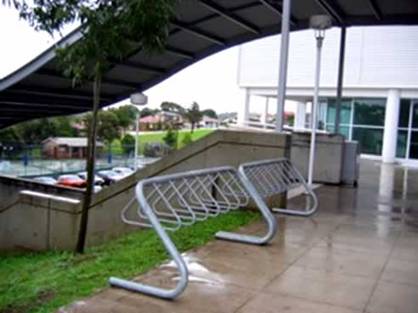
This is another popular rack that holds the bicycle frame and can be used with a U-lock.
What doesn't work: Old fashioned “wheelbender” racks that hold only the bicycle’s wheel, and are unsuitable for use with a U-shaped shackle lock. Experienced cyclists will not use them.
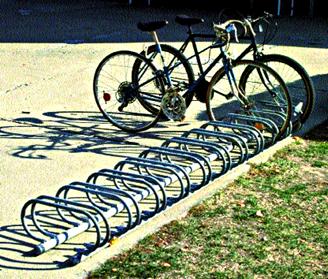
Many cyclists will not use a rack that only hold the wheel or is unsuitable for a U-lock.
Wave-style racks (a pipe or bar with a series of U-shaped bends) are not optimal. Bicycles parked perpendicular to a wave rack (as intended) are not supported in two places and so tend to fall over, and their actual capacity is usually much less than advertised.
Finding a Good Location
To ensure your bicycle parking will be used, be sure to choose locations that are easy to find, convenient to use and secure enough to reasonably safeguard against bicycle theft. Facilities can be located where cycles already parked, or where recommended by bicycle advisory groups. If you want to install bicycle parking on a sidewalk if front of your building, you may need a permit.
Short-term Parking
Short-term bicycle parking provides shoppers, customers, messengers and other visitors who generally park for two hours or less a convenient and readily accessible place to park bicycles. It should be located within 50 feet of the building entrance that cyclists use. Where there is more than one building on a site, or where building has more than one main entrance, the parking must be distributed to serve all buildings or main entrances. If more than 10 short-term spaces are required, at least 50% should be covered.
Only located bicycle racks on a sidewalk or path where there is adequate clearance for pedestrian traffic. A rail or eyelets secured onto a building wall can sometimes provide a place to lock a bicycle where it is out of the way of traffic.
What works: Locate parking in visible and prominent locations - if cyclists are unaware of the parking it won’t be used.
What doesn't work: Isolation - a bicycle rack that is visually or physically isolated will not be used and is a target for thieves. In the way of pedestrian traffic. Inadequate space to maneuver a bicycle and its gear.
Long-term Parking
Long-term bicycle parking provides employees, students, residents, commuters and others who stay at a site for several hours a secure and weather-protected place to store their bicycles. Locate on site or within 750 feet of the site - daily bicycle commuters are generally willing to walk a short distance, about three blocks, if they are confident the parking is secure. The following are suitable:
· A locked room or area enclosed by a fence with a locked gate.
· Within view or within 100 feet of an attendant or security guard.
· An area that is monitored by a security camera.
· A location that is visible from employee work areas.
What works: Cyclists are more likely to park where their bicycles are safe and protected from weather. At least 50% of long-term bicycle parking should be covered. Indoor storage is best. It is often possible to find a secure room, or an area in a basement or under stairs. Bicycle parking can often use odd-shaped interior spaces that have few other purposes. Wall-mounted racks are well suited to indoor storage. Locate in well-lit areas - lighting increases security of property and personal safety. In areas where security is in question or where there is limited opportunity to provide weather protection, enclosed bike lockers are a good best solution. In some situations cyclists pay a monthly fee to lease such lockers.
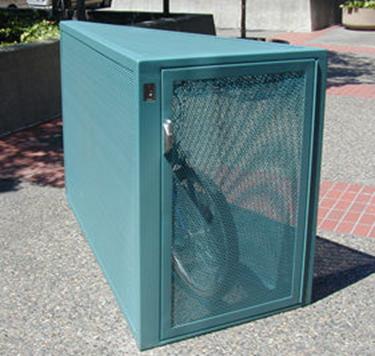
Bicycle lockers are a good choice for secure bicycle storage.
What doesn't work: Isolation - a bicycle rack that is visibly or physically isolated will not be used and is a target for thieves.
Spacing and Siting Standards
Each bicycle parking space should be easily accessible. Cyclists should be able to securely lock their bicycles without undue inconvenience and their bicycles should be reasonably safeguarded from intentional or accidental damage. Consider the space that a rack full of bicycles will take up, not just the rack itself. Also consider that cyclists require a sufficient pathway in and out of the parking area.
Each parking space must be accessible without moving another bicycle - generally, allow for 2 feet by 6 feet for each bicycle parking space. Provide an aisle at least 5 feet wide behind all bicycle parking to allow room for maneuvering - just as automobile drivers need additional space to maneuver in and out of parking spaces.
What works: Staggered racks - some bicycle racks can be staggered on 17 inch centers allowing room for more bicycles to be parked.
What doesn't work: Installing bicycle racks too close to a wall or too close to each other - installing racks improperly can cut capacity as much as 90%. Installing bicycle racks too close to car parking - motorists will seldom leave sufficient room for bicycles to park and maneuver if bicycle parking is not sufficiently separated from car parking.
Covered Bicycle Parking
Prolonged exposure to rain can rust a bike's metal frame and components and the sun's ultraviolet rays can deteriorate a bike's soft seat and tires. Cyclists who value their bicycles will thank you for providing weather protection by giving you their business. Cover must be permanent - the cover should be designed to protect the bicycle from rainfall and be at least 7 feet above the floor or ground.
What works: Take advantage of existing overhangs or awnings - this is a creative, low-cost way of providing some weather. If there is no existing opportunity to provide cover, enclosed bicycle lockers may be the best solution.
What doesn't work: Partial cover or cover that is too high - cover is intended to protect bicycles from rain and sun as well as protect cyclists from rain when they are locking or unlocking their bicycle.
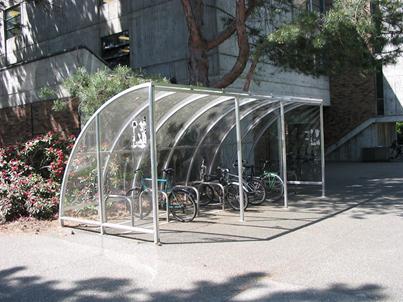
Long-term bicycle storage should be covered.
Shower and Changing Facilities
Commuters who bicycle or walk often arrive wet, muddy or sweaty. Providing employees with a place to shower, change and store clothes can encourage bicycle commuting. Such facilities also benefit employees who exercise during breaks or may occasionally need to wash and change clothes for other reasons. There are several ways that employers can provide such facilities.
· A shower and clothes lockers can be designed into new or retrofitted buildings.
· A shower and clothes lockers can sometimes be added to existing restrooms. A single shower stall and space to change clothes typically requires a six by four foot space.
· Several businesses located close together, or a Transportation Management Association, can establish shower and changing facilities that are shared by employees at several buildings.
· Employers can arrange to use showers and changing rooms at a nearby recreation center or gym. This may require special arrangements to access the facilities when they would otherwise be closed.
Sign Parking Signs
Signs serve several purposes. They let cyclists know you have bicycle parking and that their business is valued. Signs also help cyclists find your parking if it is not immediately visible or direct long-term users to intended long-term parking, keeping more short-term parking open for your customers. A sign must be posted at the main building entrance indicating the location of the parking - this will help customers locate your parking facility if it is not visible from where they approach your site.
What works: Standard bicycle parking signs made of high-quality materials.
What doesn't work: Complicated signing schemes - if a complicated signing scheme is needed to find your bicycle parking, you may need to find a better location.
Signs that discourage bicycling - signs prohibiting bicycle parking when no alternative is available only create ill-will.
Bicycle Parking Standards
Most existing zoning codes require a minimum supply of automobile parking at buildings building and other facilities. Some communities now have similar standards for bicycle parking, or allow bicycle parking to substitute for a portion of automobile parking. Tables 1 and 2 illustrate examples of such standards.
Table 1 Minimum Bicycle Parking Requirements (Portland)
|
Type of Establishment |
Minimum Number of Bicycle Parking Spaces |
|
Primary or secondary school |
10% of the number of students, plus 3% of the number of employees. |
|
College or university classrooms |
6% of the number of students, plus 3% of the number of employees. |
|
Dorms, fraternities and sororities |
One space per 3 residents. |
|
Commercial – retail or office |
One space per 3,000 sq. ft. of commercial space or 5-10% of the number of automobile spaces. |
|
Sport and recreation center |
10-20% of the number of automobile spaces. |
|
Movie theater or restaurant |
5-10% of the number of automobile spaces. |
|
Industrial |
2-5% of the number of automobile spaces. |
|
Multi-unit housing |
1 space per 1-2 apartments. |
|
Public transit stations |
Varies, depending on usage. |
Table 2 Example of Bicycle Parking Requirements (Litman, et al, 1999)
|
Land Use |
Bicycle Spaces Required |
Type |
|
RESIDENTIAL |
|
|
|
Single family / two family |
N/A |
N/A |
|
Apartment / Townhouse |
1 per unit plus 6 space rack at each building entrance. |
Class I 100% Class II 6 space rack |
|
COMERCIAL |
|
|
|
Hotel / Motel |
1 per 15 rooms. In addition, when hotel/motel is greater than 75 rooms, a 6 space visitor rack shall be provided |
Class I 60% Class II 40% |
|
Office, retail sales of goods and services, restaurants, research establishments, laboratories |
1 per 250 m2 GFA for the first 5000 m2 and 1 per 500 m2 for any additional area |
Class I 50% Class II 50% |
|
Shopping Centre |
1 per 250 m2 of gross leasable area for the first 3000 m2 and 1 per 500 m2 of gross leasable area for any additional area. |
Class I 30% Class II 70% |
|
INDUSTRIAL (ALL) |
1 per 950 m2 GFA |
Class I 80% Class II 20% |
|
INSTITUTIONAL |
|
|
|
Hospitals |
1 per 500 m2 |
Class I 75% Class II 25% |
|
Schools |
All levels: 1 per 10 employees |
Class I employees college, university 10% Class II students |
|
Elementary |
1 per 10 students |
|
|
Junior Secondary |
1 per 8 students |
|
|
Senior Secondary |
1 per 8 students |
|
|
College |
1 per 5 students |
|
|
University |
1 per 5 students (full time, max. attendance) |
|
|
Churches |
1 per 50 members |
Class II 100% |
|
Library / Museum/ Art Gallery |
a per 100 m2 GFA |
Class I 20% Class II 80% |
|
Personal Care / Nursing Home / Group Home |
1 per 15 dwelling units |
Class I 75% Class II 25% |
|
Correctional Institutions |
1 per 50 beds |
Class I 70% Class II 30% |
|
CULTURAL AND RECREATIONAL |
|
|
|
Community Centre |
1 per 80 m2 of GFA |
Class I 20% Class II 80% |
|
Stadium, Arena, Pool, Exhibition Hall, similar places with spectator facilities |
1 per 100 m2 of surface area |
Class I 20% Class II 80% |
|
Gymnasium, Health Spa |
1 per 80 m2 of surface area |
Class I 20% Class II 80% |
|
Bowling Alley, Curling Rink |
1 per 2 alleys or sheets |
Class I 20% Class II 80% |
Class I bicycle parking provides complete protection for a bicycle and equipment. Class II facilities are racks that a bicycle can be securely locked to.
The City of Vancouver (2003) Requirement for Shower/Change Rooms (By-law 7481) specifies the number of water closets, wash basins and showers required at a new building, based on the number of bicycle racks required.
Table 3 Vancouver Shower/Change Rooms (Vancouver, 2003)
Required Class A Bike Spaces |
Minimum Number for Each Sex |
||
|
|
Water Closets |
Wash Basins |
Showers |
|
0-3 |
0 |
0 |
0 |
|
4-29 |
1 |
1 |
1 |
|
30-64 |
2 |
1 |
2 |
|
65-94 |
3 |
2 |
3 |
|
95-129 |
4 |
2 |
4 |
|
130-159 |
5 |
3 |
5 |
|
160-194 |
6 |
3 |
6 |
|
Over 194 |
6 plus one for each additional 30 bike spaces or part thereof |
3 plus one for each additional 30 bike spaces or part thereof |
6 plus one for each additional 30 bike spaces or part thereof |
Additional examples of bicycle parking standards can be found for:
Boston, MA (www.massbike.org/bikelaw/pboston.htm)
Cambridge, MA (www.massbike.org/bikelaw/pcamb.htm)
Watertown, MA (www.massbike.org/bikelaw/pwtrtown.htm)
Santa Cruz, CA (www.massbike.org/bikelaw/pscruz.htm)
Denver, CO (www.massbike.org/bikelaw/pdenver.htm)
Iowa City, Iowa (http://danenet.wicip.org/bcp/bic/pordinance.html)
Comparison of nine bike parking ordinances (www.massbike.org/bikelaw/parkcomp.htm)
MassBike Bicycle Parking Information (www.massbike.org/bikelaw/parking.htm)
|
What Would Get Americans Biking to Work? Decent Parking. By Tom Vanderbilt, Slate Magazine (www.slate.com/id/2225511), 17 Aug. 2009 When we talk about transportation, we tend to talk about things in motion. What is often left unremarked upon, in conversations about crowded highways, is something without which those crowds would not exist: parking. That humble 9-by-18-foot space (the standard size of a spot) is where traffic begins and ends. It is the fuel to traffic's fire.
Why is it overlooked? One possibility is that parking is more typically treated as real estate, the subject of arcane building codes and zoning regulations, rather than as a part of transportation networks; given that cars spend 95 percent of their time parked, this makes some sense. Another reason may simply be that, in most of America, parking is taken as a given. Donald Shoup, author of The High Cost of Free Parking, has estimated that 99 percent of car trips in the United States terminate in a free parking space, which means the nation's drivers don't have much incentive to think about parking—or not driving. In many American places, there are more parking spaces than people.
If car parking is often overshadowed in traffic talk, bicycle parking is even more obscure. For many people in the United States it might be hard to imagine what there is to talk about. Why don't you just stick it in the garage? Or: Isn't that what street signs and trees are for? But as the share of trips made by bicycle has grown in recent years—in Portland, Ore., for example, bicycle use has grown nearly 150 percent since 1990, and an estimated 5 percent of people bike to work—new attention is being paid to what happens to those bicycles when they are not in motion. The most high-profile instance of this is the so-called "Bicycle Access Bill," recently signed into law after a New York City Council vote of 46-1. The measure will require the owners of commercial buildings with a freight elevator to allow people to enter the building with a bicycle—though what happens from there depends on the building. (See this useful summary of the bill.)
While the right to enter a building with a bicycle may seem minor, the bill potentially represents a huge de facto increase in the city's supply of bicycle parking, which is currently estimated at 6,100 racks, many of these outdoors. What's more, New York's City Council also passed a bill mandating that commercial parking garages provide spaces for bicycles—one bike space for every 10 cars, up to 200 cars.
Why do these measures matter? Because parking helps make commuters—a lesson long ago learned with cars. Studies in New York found that a surprisingly large percentage of vehicles coming into lower Manhattan were government employees or others who had an assured parking spot. Other studies have shown the presence of a guaranteed parking spot at home—required in new residential developments—is what turns a New Yorker into a car commuter. On the flip side, people would be much less likely to drive into Manhattan if they knew their expensive car was likely to be stolen, vandalized, or taken away by police. And yet this is what was being asked of bicycle commuters, save those lucky few who work in a handful of buildings that provide indoor bicycle parking. Surveys have shown that the leading deterrent to potential bicycle commuters is lack of a safe, secure parking spot on the other end. (In England, for example, it's been estimated that a bicycle is stolen every 71 seconds.)
A number of American cities are now waking up to the fact that providing bicycle parking makes sense. Philadelphia, for example, recently amended its zoning requirements to mandate that certain new developments provide bicycle parking; Pittsburgh's planning department is weighing requiring one bicycle parking space for every 20,000 square feet of development* (admittedly modest compared with the not-uncommon car equation of one parking space per 250 square feet); even the car-centric enclave of Orange County, Calif., is getting in on the act, with Santa Ana's City Council unanimously passing a bill requiring proportional bicycle parking when car parking is provided. In Chicago, Los Angeles, and other cities, pilot projects are investigating turning car-parking meters—once semireliable bike-parking spots, now rendered obsolete by "smart meter" payment systems—into bike parking infrastructure.
Few cities are doing more than Portland—which has been experiencing a particular boom in bicycle commuting—to increase bicycle parking. In September, for example, the City Council will vote on code changes that would require residential buildings to have the same bicycle parking requirements as commercial buildings. Granted, Portland, Ore., is an unusual place for the United States: a place where business owners actually petition the city to build "bike corrals," or collections of racks that tend to swap one or two car parking spaces for a dozen bike spaces, in front of their establishments, and where residents casually drop lingo like staple, meaning the type of bicycle parking structure that looks like a staple stuck into the concrete. And in a move that is sure to give John McCain fits, the city is spending $1 million of federal stimulus funds on bicycle parking at transit hubs.
Of course, even Portland's efforts would look rather quaint in a country like the Netherlands, where an estimated 27 percent of daily trips are made on bicycle. Outside of, or underneath, Dutch railway stations in the major cities sit vast bicycle parking structures. In fact, parking is so readily available that many riders keep a bike at their origin and destination stations. The three-story parking-garage-style facility outside Amsterdam's Central Station holds some 9,000 bikes, while Groningen has a massive, covered and guarded facility that holds 4,500 bikes. And yet even these structures do not seem to meet demand.
The spatial and aesthetic challenges of having too many parked bikes attached to every last lamppost and historic building has prompted some wonderfully innovative design and market responses. The underground "Bicycle Parking Tower"—actually a series of 36 towers—at the Kasai Station in Edogawa, Tokyo, holds more than 9,000 bicycles, any of which can be retrieved within 23 seconds via an automated mechanism. In Zaragoza and a few other Spanish cities, meanwhile, the Biceberg, a small kiosk beneath which sits a storage bay, creates spots for 92 bicycles in the same space that four cars would occupy. Another approach is to combine guarded bicycle parking in a one-stop facility with mechanics, bike stores, education, and other services, as with Brazil's ASCOBIKE. Muenster's "Radstation" comes complete with a bicycle wash—for $4. In the United States, the for-profit Bikestation sells secure parking ("valet and controlled access") and provides air for tires as well as showers and Wi-Fi in its "bike-transit centers," in cities ranging from Santa Barbara, Calif., to Seattle. At Washington, D.C.'s Union Station, a similar concept — with everything from rentals to repairs — is scheduled to open in August, a swooping shell of glass and tubes, designed by KPG and at least partially inspired by the arc of a bicycle wheel.
Of course, even in a bicycling paradise like Copenhagen, bicycle parking is hardly ideal. "Parking is the last great challenge in a bike culture," as Mikael Colville-Andersen, who writes the Copenhagenize blog, told me. In its 2004 "Traffic and Environment Plan," the city of Copenhagen, noting that bike parking wasn't even assessed until 2001 (when it was found there were 2,900 spaces in the historic center), declared: "Only one third of cyclists are satisfied with their options for parking their bicycles and other road users, particularly walkers, are increasingly annoyed by parked cycles."
This last point brings up another problem: So-called "bicycle pollution," or the clutter of masses of bikes chained to every last railing. In a city where bikes outnumber people, this is perhaps inevitable, but it's also a function of the inherent appeal of bikes—literal door-to-door transportation. As Colville-Andersen put it, "people prefer to park on the street, leaning the bikes up against the building. It's all about ease-of-use. If you can't walk out your door and get on your bike in under 30 seconds, it's irritating." Still, space has its limits, and in a design competition to upgrade Vartov Square, next to Copenhagen's City Hall—which the mayor's office notes "mainly looks like a cluttered and worn parking area"—there is a call for underground bicycle parking. Meanwhile, back in Portland, Ore., as bicycle parking gets more respect, another bastion of the automobile landscape is getting a makeover: access, and perhaps even special lanes, for bicycles at the drive-throughs of fast-food joints. |
Best Practices
For information on the design, selection and installation of bicycle parking and changing facilities see Browning (1999), APBP (2010) and DfT (2003). Below are some general recommendations.
· Provide suitable bicycle parking where cyclists stop, with racks that maximize convenience for short-duration stops (such as stores and bank entrances) and storage facilities that maximize security for longer-duration stops (such as schools, worksites and transportation terminals).
· Provide well-protected, long-term bicycle parking for commuters, residents or anywhere else cyclists will leave a bicycle for several hours. If possible, also provide showers and clothes lockers for bicycle commuters.
· Locate bicycle parking where it is convenient to use, secure, visible, protected from weather, and has adequate clearance.
· Do not locate bicycle racks where they are in the way of pedestrian traffic. Minimizes hazards to other traffic (pedestrians etc).
· Design bike rack to be intuitive to use, attractive and integrated into the streetscape. Bicycle racks and lockers should be made of heavy-duty, durable, vandal-resistant materials that are securely anchored.
· Racks should hold the bike upright (usually two points of contact in a horizontal plane), allow the frame and both wheels to be locked, and minimize the risk of scratching a frame.
· Racks should be designed to accommodate commonly used bicycle locks (U-locks and cable locks).
|
A minister and priest had the habit of drinking together at the local pub each Monday evening to share the pleasures and pains of their calling. One week the minister arrived on foot rather than cycling as usual. When the priest asked why, he complained, “Somebody stole my bicycle! This evening it was missing from its normal parking space. One of my parishioners must have taken it. What should I do?”
“That’s terrible!” replied the priest. “Here’s what I suggest. Next Sunday, base your sermon on the ten commandments. Make it passionate, with lots of fire and brimstone, so your flock really squirms. When you get to ‘Thou shall not steal’, see who looks guilty. Then you’ll find your suspect!”
The minister thought that sounded like a good plan. The next Monday he arrived at the pub by bicycle as usual. The priest asked how the plan had worked.
“Oh, it succeeded just fine,” He answered. “I was working through the ten commandments, and when I got to the one about adultery, I remembered where I left my bicycle!” |
Manufactures and Vendors
Below are links to some bicycle rack manufactures and vendors. This is only a partial list so we recommend performing an Internet search for more sources.
American Bicycle Security Co. (www.ameribike.com) sells a wide variety of bicycle racks and bike lockers.
Bike Hive (www.bikehive.com) produces bike storage lockers suitable for indoor and outdoor use.
Bikelink (www.bikelink.org) produces and distributes secure bicycle lockers that use electronic cards which serve as both a payment system and a key.
Bike-Up Bicycle Parking Systems (www.bikeup.com) sells a variety of bicycle racks.
Cora Bike Rack (www.cora.com) is a specialized manufacturer of bicycle parking systems.
Creative Pipe, Inc. (www.creativepipe.com) manufactures bicycle racks, lockers and bollards.
Cycle-Safe, Inc. (www.cycle-safe.com) manufactures bicycle racks and lockers.
Dero Bike Rack Company (www.dero.com), manufactures a variety of interesting designs, and provides detailed drawings and dimensions of their racks on the website.
Dobra Design Bicycle Parking Systems (www.dobradesign.com) sells a wide range of interior and exterior bicycle racks and stands.
Graber Products (www.graberproducts.com).
Guardian Bicycle Locker System (www.spiplastics.com/bicycle-lockers.htm) manufactures low maintenance bike lockers from plastic.
JOSTA Designs (www.josta.de/english) is a German manufacturer of bicycle parking systems.
SPI Industries (www.spiplastics.com/bikelock.htm) is a Canadian manufacturer of plastic bike lockers.
SportWorks (www.bicycleracks.com) manufactures a variety of bike racks.
Sunshine Corporation (www.sunshineu-lok.com) produces secure bicycle parking equipment, including racks designed to attach to parking-meter poles or signposts, and lockers.
References And Resources For More Information
ADONIS (1999), Best Practice to Promote Cycling and Walking and How to Substitute Short Car Trips by Cycling and Walking, ADONIS Transport RTD Program, European Union (www.cordis.lu/transport/src/adonisrep.htm). This 300-page catalogue describes dozens of strategies to help improve and encourage walking and cycling, ranging from special facilities, to safety campaigns and traffic management to facilitate street crossing.
Alta Planning + Design (2005), Caltrans Pedestrian and Bicycle Facilities Technical Reference Guide: A Technical Reference and Technology Transfer Synthesis for Caltrans Planners and Engineers, California Department of Transportation (www.dot.ca.gov/hq/traffops/survey/pedestrian/TR_MAY0405.pdf).
Troels Andersen, et al. (2012), Collection of Cycle Concepts, Cycling Embassy of Denmark (www.cycling-embassy.dk); at www.cycling-embassy.dk/2012/05/10/cycle-concepts2012.
APBP (2010), Bicycle Parking Guidelines, Association of Pedestrian and Bicycle Professionals (www.apbp.org); at www.apbp.org/?page=Publications.
Ilona Bos and Arnoud Van de Vrugt (2008), Park and Bike: New Multimodal Concept for Congested Areas, Transportation Research Board 87th Annual Meeting (www.trb.org).
Bicycle Coalition of Massachusetts Bicycle Parking Information (www.massbike.org/bikelaw/parking.htm) provides bicycle parking bylaws and manufactures contacts.
Bicycle Information Center (www.bicyclinginfo.org) provides information on nonmotorized transport planning and programs.
Bicycle Federation of America (www.bikefed.org) provides extensive resources for bicycle and pedestrian planning.
Bicyclepedia (www.bicyclinginfo.org/bikecost) is a bicycle facility benefit/cost analysis tool available free on the Internet.
Rick Browning (1999), End-0f-The-Trip Facility Design Program, Oregon Department of Environmental Quality (www.deq.state.or.us). This is a set of excellent information sheets on bicycle parking facilities that are now available at the Victoria Transport Policy Institute website:
“Installing Secure and Convenient Bike Racks” (www.vtpi.org/bp1.pdf)
“Providing Covered Bike Parking” (www.vtpi.org/bp2.pdf)
“Bike Parking in Public Areas” (www.vtpi.org/bp3.pdf)
“Indoor Bicycle Parking” (www.vtpi.org/bp4.pdf)
“Lockers, Showers and Changing Rooms” (www.vtpi.org/bp5.pdf)
BTS, Pedestrian and Cycling Publications, Bureau of Transportation Statistics, USDOT, (www.bts.gov/NTL/subjects/ped-bike.html).
Max A. Bushell, Bryan W. Poole, Charles V. Zegeer and Daniel A. Rodriguez (2013), Costs for Pedestrian and Bicyclist Infrastructure Improvements: A Resource for Researchers, Engineers, Planners, and the General Public, Pedestrian and Bicycle Information Center (www.walkinginfo.org), Federal Highway Administration; at www.walkinginfo.org/download/PedBikeCosts.pdf.
CBW (2009), Bicycles At Rest: A Bicycle Parking Best Practices Guide (www.bicycleparkingonline.org), Capital Bike and Walk Society (www.capitalbikeandwalk.org).
Calgary (2002), Bicycle Parking Handbook: A Developer’s Guide, Planning and Transportation Policy, City of Calgary (www.calgary.ca); at www.ciudadviva.cl/sitio/images/stories/PDF/Calgary.pdf.
CROW (1997), Bicycle Parking in the Netherlands, Centre for Research and Contract Standardization in Civil and Traffic Engineering (www.crow.nl).
Cycle Connect (2004), Cycle Connect Guidelines: Bicycle Lockers At Public Transport Nodes, Australian Department of Environment and Heritage (www.deh.gov.au/atmosphere/airquality/cycleconnect.html).
CycleStation (www.QISystemsInc.com) is a card-activated bicycle management system that secures and tracks each bike with a unique ID and locking mechanism suitable for use in parks, cities, universities, corporate campuses and resorts.
Dero (2010), Bike Parking Guide, Dero Bike Racks (www.dero.com); at www.dero.com/bike-rack-guide.
DfT (2003), Parking and Security, National Cycling Strategy, (www.nationalcyclingstrategy.org.uk), Department for Transport.
ITE (1998), Implementing Bicycle Improvements at the Local Level, ITE, Federal Highway Administration (available online at www.bikefed.org/local.htm).
Todd Litman, et al (2000), Pedestrian and Bicycle Planning; A Guide to Best Practices, VTPI (www.vtpi.org). Comprehensive guide with extensive references.
Todd Litman (2013), Evaluating Active Transport Benefits and Costs: Guide to Valuing Walking and Cycling Improvements and Encouragement Programs, Victoria Transport Policy Institute (www.vtpi.org); at www.vtpi.org/nmt-tdm.pdf; originally published as “Bicycling and Transportation Demand Management,” Transportation Research Record 1441, 1994, pp. 134-140.
Karel Martens (2007), “Promoting Bike-and-Ride: The Dutch Experience,” Transportation Research, Vol. 41, Issue 4 (www.elsevier.com/locate/tra), May 2007, pp. 326-338.
NSW (2004), Planning Guidelines for Walking and Cycling, Department of Infrastructure, Planning and Natural Resources (www.planning.nsw.gov.au); at www.planning.nsw.gov.au/plansforaction/pdf/guide_pages.pdf.
ODOT (1995), Oregon Bicycle and Pedestrian Plan, Oregon Department of Transportation (www.oregon.gov/ODOT); at www.oregon.gov/ODOT/HWY/BIKEPED/planproc.shtml.
Portland Bicycle Parking Facilities Guidelines (www.trans.ci.portland.or.us/Traffic_Management/Bicycle_Program/parkguide.htm).
TA (2002), Bicycle Parking Solutions: A Resource for Installing Indoor Bicycle Parking, Transportation Alternatives (www.transalt.org); at www.transalt.org/campaigns/bike/bikeparking.pdf
Vancouver (2003), Bicycle Parking Design Supplement and Requirement for Shower/Change Rooms (By-law 7481), Community Services, City of Vancouver (www.city.vancouver.bc.ca); at www.city.vancouver.bc.ca/engsvcs/parking/admin/developers.htm.
This Encyclopedia is produced by the Victoria Transport Policy Institute to help improve understanding of Transportation Demand Management. It is an ongoing project. Please send us your comments and suggestions for improvement.
Victoria Transport Policy Institute
www.vtpi.org info@vtpi.org
1250 Rudlin Street, Victoria, BC, V8V 3R7, CANADA
Phone & Fax 250-360-1560
#85