Small Wheeled Transport
Wheeled Luggage, Skating, Scooters, Hand Carts and Wagons
~~~~~~~~~~~~~~
Victoria Transport Policy Institute
~~~~~~~~~~~~~~~~~~~~
Updated 15 May 2014
This chapter describes Small-Wheeled vehicles such as wheeled luggage, walkers, skates, scooters and handcarts, how these modes support TDM, and how to better accommodate them.
Description
Small-Wheeled Transport includes travel involving wheeled luggage, walkers, skates, skateboards, push scooter, Segway, handcarts and wagons. They are (mostly) a category of Nonmotorized Transportation.
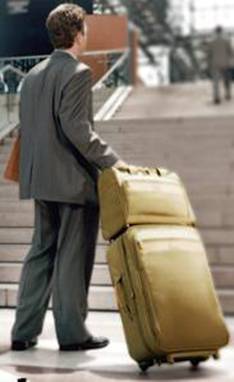
· Wheeled luggage increases the amount of baggage that pedestrian can reasonably carry and expands reasonable walking distances. This reduces the need to rely on motorized modes for various errands and connections between modes.
· Walkers (rollators) provide improved mobility for people who have difficulty walking.

Walker (also called a “rollator”)
· Skates, skateboards, scooters and Segway are used for trips that would otherwise be made by automobile. In some urban areas it is common to see people ride them to school, work and for errands.

This is an example of a small, foldable scooter that can be uses for errands and to access transit.
· Skates, skateboards and foldable push scooters are particularly appropriate for accessing public transit. For example, a push scooter can approximately double travel speeds for short distances, significantly increasing the area that can be Accessed within 10 minutes of a transit stop.

This is an example of a small, foldable electric-powered scooter that can be used for errands and to access transit.
· Handcarts and wagons allow pedestrians to carry heavy and awkward loads. These can often substitutes for motorized vehicles for deliveries within a factory or campus facility, and for personal shopping trips and other errands.

Industrial wagons and carts such as these sometimes substitute for motorized vehicles.
Small Wheeled vehicles require relatively smooth travel surfaces, with curbcuts and ramps instead of stairs, and adequate width. This can be implemented as part of Pedestrian Improvements that meet Universal Design standards. It also requires integration with other modes, such as provisions for carrying foldable scooters and inline skates on transit vehicles, and a place to store equipment and change clothes at worksites (Bicycle Parking).
A common barrier to Small Wheeled transport is the tendency of public officials to ban skates and push scooters, particularly in urban centers where they are most suitable as a transportation mode, because they are perceived as a hazard or nuisance. A more supportive response is to implement Nonmotorized Facility Management programs that encourage responsible behavior by users.
|
Skates and Scooters – Recommended Standards of Behavior · Control your speed when approaching other path or road users. Travel at a walking speed and use caution on crowded sidewalks and paths. · Always yield to pedestrians. · Do not skate or scoot where prohibited or hazardous. Follow any special rules that apply to skates or scooters. · Pass pedestrians on the left, announcing your presence, or use a bell. · When traveling with others, form a single file when needed to avoid crowding others. · When traveling on the roadway, skate or scooter in the direction of traffic and follow vehicle or bicycle traffic rules. Anticipate opening car doors. · Do not weave in and out of traffic or parked cars. · Never use a vehicle or bicycle to pull a skater or scooter. · Do not use earphones, cellular phones or other devices that may distract your attention. · If traveling in conditions of poor visibility use bright lights visible from all sides, and reflective clothing. · Never skate or scoot when intoxicated. · Maintain your wheels, bearings and brakes. · Wear proper protective gear (helmets and pads) appropriate for your level of skill and travel conditions. |
How It Is Implemented
Small Wheeled Transport improvements are usually implemented as part of Complete Streets Policies, Nonmotorized Planning, Nonmotorized Facility Management and Maintenance, Pedestrian Improvements and Universal Design.
Travel Impacts
Small Wheeled modes can substitute for automobile travel, particularly as an access mode for transit. Push carts can be important for goods delivery, particularly in dense commercial centers. Their total travel impacts are relatively modest.
Table 1 Travel Impact Summary
|
Objective |
Rating |
Comments |
|
Reduces total traffic. |
1 |
|
|
Reduces peak period traffic. |
1 |
|
|
Shifts peak to off-peak periods. |
0 |
|
|
Shifts automobile travel to alternative modes. |
1 |
|
|
Improves access, reduces the need for travel. |
0 |
|
|
Increased ridesharing. |
0 |
|
|
Increased public transit. |
1 |
Can provide access to transit. |
|
Increased cycling. |
0 |
|
|
Increased walking. |
1 |
Can be considered a form of pedestrian travel. |
|
Increased Telework. |
0 |
|
|
Reduced freight traffic. |
1 |
Shop wagons and carts can carry loads |
Rating from 3 (very beneficial) to –3 (very harmful). A 0 indicates no impact or mixed impacts.
Benefits and Costs
Benefits include increased Transportation Choices and reductions in short automobile trips. They may increase risks of falls and crashes to users, but they also provide Healthy aerobic exercise. They can reduce automobile traffic and increase sidewalk activity, which tends to increase community Livability, but some pedestrians consider them a nuisance.
Table 2 Benefit Summary
|
Objective |
Rating |
Comments |
|
Congestion Reduction |
1 |
Can reduce automobile trips. |
|
Road & Parking Savings |
1 |
|
|
Consumer Savings |
1 |
|
|
Transport Choice |
2 |
|
|
Road Safety |
0 |
May result in injury risk to users, but is a form of aerobic exercise. |
|
Environmental Protection |
1 |
Reduces short vehicle trips. |
|
Efficient Land Use |
1 |
Encourages clustered land use. |
|
Community Livability |
1 |
Can increase community livability, but some pedestrians consider them a nuisance. |
Rating from 3 (very beneficial) to –3 (very harmful). A 0 indicates no impact or mixed impacts.
Equity Impacts
Small Wheeled transport can provide affordable transportation to non-drivers. For some people they are an important utilitarian mode.
Table 3 Equity Summary
|
Criteria |
Rating |
Comments |
|
Treats everybody equally. |
0 |
|
|
Individuals bear the costs they impose. |
0 |
Some pedestrians consider them a nuisance. |
|
Progressive with respect to income. |
0 |
|
|
Benefits transportation disadvantaged. |
1 |
|
|
Improves basic mobility. |
2 |
|
Rating from 3 (very beneficial) to –3 (very harmful). A 0 indicates no impact or mixed impacts.
Applications
Small Wheeled Transport can be used anywhere there are paved roads or paths, and are particularly appropriate in higher-density, pedestrian-oriented areas, such as commercial centers and Campuses. Planning and improvements for Small Wheeled Transport are primarily implemented by local governments, as part of Nonmotorized Transport Planning and Universal Design, and by individual businesses.
Table 4 Application Summary
|
Geographic |
Rating |
Organization |
Rating |
|
Large urban region. |
1 |
Federal government. |
0 |
|
High-density, urban. |
2 |
State/provincial government. |
1 |
|
Medium-density, urban/suburban. |
2 |
Regional government. |
1 |
|
Town. |
2 |
Municipal/local government. |
2 |
|
Low-density, rural. |
1 |
Business Associations/TMA. |
1 |
|
Commercial center. |
2 |
Individual business. |
2 |
|
Residential neighborhood. |
2 |
Developer. |
1 |
|
Resort/recreation area. |
2 |
Neighborhood association. |
1 |
|
College/university communities. |
3 |
Campus. |
3 |
Ratings range from 0 (not appropriate) to 3 (very appropriate).
Category
Improves Transport Choice
Relationships With Other TDM Strategies
Small Wheeled Transport is supported by Nonmotorized Transportation Planning and Pedestrian Improvement. Universal Design can result in curbcuts, and smoother and wider paths that better accommodate Small Wheeled vehicles. Small Wheeled Transport can be supported by Traffic Calming, Commute Trip Reduction and New Urbanism.
Stakeholders
Nonmotorized transportation improvements are usually implemented by local or regional governments, sometimes with state or provincial transportation agency support. Some measures, such as sidewalks and paths, are partly implemented by businesses and developers. Universal Design is implemented by developers and local governments, often based on standards set by higher levels of government or professional organizations.
|
“When I was a boy of fourteen, my father was so ignorant I could hardly stand to have the old man around. But when I got to be twenty-one, I was astonished at how much he had learned in seven years.” – Mark Twain |
Barriers To Implementation
Small Wheeled Transport is often ignored by transportation professionals and citizens. It is often treated as a toy or a nuisance. Low-density, dispersed land use patterns can reduce the practicality of Small Wheeled Transport.
|
“Yet Another Helmet Law? Let's Skip It” by Charles Komanoff, Daily News (New York City), January 10, 2001
See if you can guess my choice for vehicle of the year. It's an environmentalist's dream, completely nonpolluting and practically inaudible. It's small and nimble, perfect for traffic-clogged cities and suburbs.
Yes, it's slow, with a top speed below 10 mph, and it carries only one person - the driver. But because it's so slow and small, it's harmless. At $99 or under, it's dirt-cheap. And it's fun!
Sound too good to be true? A lot of people seem to think so. Dozens of states and cities - including New York City - have laws in the works that would keep people away from such vehicles.
As you've probably guessed, my vehicle of the year is the folding push-scooter. Push-scooters have sold like wildfire - several million in their first year. But here comes the crackdown, under the dubious guise of safety. With so many scooters in use, there were bound to be some injuries. In September, federal safety officials totaled the sprains and fractures and issued an advisory. The media snapped it up. Then, a week later, a car ran over a 6-year-old on a scooter in Elizabeth, N.J.
So a half-dozen burgs in the Northeast, including Elizabeth, have banned scooting unless the child wears a helmet. And tomorrow, the New York City Council's Health Committee will hold a hearing on a bill to require helmets for scooter riders 14 and younger.
No one is questioning whether this is really in the kids' interest. In fact, it's not. Helmets won't save scooter kids. That would require doing something about cars - slowing them down, for example, and making drivers observe kids' and other pedestrians' right of way.
The boy in Elizabeth was one of the thousand or so children killed by cars in U.S. residential neighborhoods each year, including 15 to 20 in New York City. Typically in these cases, the body is crushed or the impact to the head is too severe for a helmet to help. A helmet wouldn't have saved the boy in Elizabeth, the police officer at the scene said.
Fortunately, scooting is done mostly on sidewalks, in schoolyards and in parks where motor vehicles aren't permitted. In those settings, serious head injuries are extremely rare. Once a kid has mastered it, scooting isn't much more hazardous than running or even walking. If scooters require helmets, then so does an afternoon at the playground.
With a helmet law, scooting would be a lot less natural, simple and convenient.
Scooters aren't a problem, they're a solution. We should be encouraging, not stifling them. Scooting is good for kids, and not just athletic ones. Almost any child can scoot and feel cool doing it. It doesn't take special equipment or facilities - although wider sidewalks would be nice.
Kids have little independent mobility as it is, and childhood obesity reportedly is reaching epidemic proportions. Scooting is a simple and inexpensive way for kids to get the exercise and regain the autonomy that previous generations enjoyed as their birthright. If we really want to make kids safer, we'll curb adult behavior that endangers them - aggressive or oblivious driving, for example.
But somehow, that's not in the legislation. We'd rather make the kids pay the price for adult privilege. And spend their childhood in perfect safety, in front of the TV, pining for the keys to the car. |
Best Practices
For more discussion of best management practices see Nonmotorized Facility Management.
· Recognize Small Wheeled Transport as a legitimate mode in transportation planning.
· Identify obstacles and barriers to Small Wheeled transport as part of Nonmotorized Transportation Planning.
· Implement Pedestrian Improvements, and use Universal Design standards such as curbcuts, ramps and paths that are adequately smooth and wide.
· Avoid restrictive policies. If Small Wheeled Transport creates conflicts with other path or road users, use standards of behavior, education and enforcement programs rather than banning them.
· Establish Education and Encouragement programs that emphasize safe and courteous use of Small Wheeled vehicles.
· Implement Transit Improvements that facilitate carrying foldable scooters, skates and skateboards on buses and trains.
· Provide changing rooms and storage lockers at worksites (Bicycle Parking).
|
Inline Skating Rules of the Road, International Inline Skating Association (www.iisa.org/rulesofroad.htm)
1. Skate Smart Always wear your protective gear—helmet, wrist protection, elbow pads, knee pads. Master the basics—striding, stopping, and turning. Keep your equipment in proper working order
2. Skate Legal Obey all traffic regulations. When on skates, you should consider yourself to be subject to the same obligations as a bicyclist or a driver of an automobile.
3. Skate Alert Skate under control at all times. Watch out for road hazards. Avoid water, oil, and sand. Avoid traffic.
4. Skate Polite Skate on the right, pass on the left. Announce your intentions by saying, "passing on your left". Always yield to pedestrians. |
References And Resources For More Information
Alan Durning (2010), Updating the "Granny Cart", Sightline Institute (www.sightline.org); at http://daily.sightline.org/daily_score/archive/2010/04/16/updating-the-granny-cart.
International Inline Skate Association (www.iisa.org) promotes inline skating and provides safety education resources.
Inline Skating Safety websites:
www.safekidscanada.ca/English/Safety_Tips/ST_InLine.html
http://persweb.direct.ca/cheney/iss.html
www.oxfordcommunitypolice.on.ca/safety.html#skate
www.city.brantford.on.ca/firedept/skate.html.
NobleMotion (www.GainTerrain.com) is a North American supplier of walkers (“Rollators”).
Portland (2001), Skating in Portland; Skate Safety and Responsibility, Office of Transportation, City of Portland (www.trans.ci.portland.or.us).
Segway Human Transporter (www.segway.com) is a small, electric-powered vehicle designed to carry one passenger on pedestrian facilities (paths, sidewalks, hallways, etc.) at a speed of up to 12.5 mph (20 km/h), and a range of up to 17 miles (28 km).
Skateboarding Safety websites:
www.mpshu.on.ca/SafetyIssues/skateboa.htm
www.mhcn.ab.ca/healthycom/healthfacts/skate.html
Small-Wheeled Transport Strategy (1994), Australian Capital Territories, Roads and Transport Branch, (cited in Road & Transport Research, Vol. 3, No. 3, Sept. 1994, p. 105).
Tony’s Trailiers (www.TonysTrailers.com) produces a variety of small trailers and handcarts.
This Encyclopedia is produced by the Victoria Transport Policy Institute to help improve understanding of Transportation Demand Management. It is an ongoing project. Please send us your comments and suggestions for improvement.
Victoria Transport Policy Institute
www.vtpi.org info@vtpi.org
1250 Rudlin Street, Victoria, BC, V8V 3R7, CANADA
Phone & Fax 250-360-1560
#90