Roadway Connectivity
Creating More Connected Roadway and Pathway Networks
~~~~~~~~~~~~~~
Victoria Transport Policy Institute
~~~~~~~~~~~~~~~~~~~~
Updated 2 January 2017
This chapter describes how improved roadway and pathway connectivity, which tends to improve accessibility and reduce vehicle travel distances.
Description
Connectivity refers to the density of connections in path or road networks, and the directness of links. A well-connected network has many short links, numerous intersections, and minimal dead-ends (cul-de-sacs). As connectivity increases, travel distances decrease and route options increase, allowing more direct travel between destinations, creating a more Accessible and Resilient system that reflects Complete Streets principles. Connectivity can apply both internally (streets within that area) and externally (connections with arterials and other neighborhoods).
Figure 1 Roadway Connectivity Impacts on Accessibility and Safety

Although points A and B are approximately the same distance apart in both maps, the functional travel distance is nearly three times farther with the poorly-connected road network which forces most trips onto major arterials. This tends to increase total vehicle travel, traffic congestion and accident risk, particularly where vehicles turn on and off major arterials (red circles), and reduces the feasibility of walking and cycling to local destinations.
Roadway connectivity decisions often involve trade-offs between travel speed, distance and modal diversity: higher traffic speeds often require reducing connectivity, by increasing the distances between intersections and limiting pedestrian crossings. There is debate concerning the relative benefits of different street patterns, particularly grid (streets are highly connected, and mostly long and straight, and parallel or perpendicular), modified grid (street are highly connected, but many are short and connect at right angles), or a hierarchical network (streets are poorly connected, most smaller residential streets are cul-de-sacs, connected to larger, higher-volume arterials). A connected road network tends to emphasize accessibility by accommodating more direct travel with traffic dispersed over more roads, while a hierarchical road network tends to emphasize mobility by accommodating higher traffic volumes and speeds on fewer roads, which increases the amount of travel required to reach destinations, concentrates traffic onto fewer roads, and creates barriers to nonmotorized travel (Gayah and Daganzo 2012). Two-way streets tend to provide more direct access to destinations than a network of one-way streets (Gayah 2012). During the 1960s through the 1990s, roadway design practices favored hierarchical networks. New Urbanism and Smart Growth land use policies support improved connectivity.
Sometimes, different levels of connectivity are intentionally applied to different modes, called filtered permeability (Cozens and Hillier 2008). For example, some urban road networks have more direct connections for walking, cycling and public transit than for private automobile (Vehicle Restrictions). A Fused Grid street design (Figure 2), uses public squares at the end of cul-de-sac streets to provide pedestrian and cycling connections that are closed to vehicle traffic (Grammenos and Lovegrove 2015). This helps improve Community Livability, encourage nonmotorized transportation and increase traffic safety (Lovegrove and Sun 2009; Zhang, et al. 2012).
Figure 2 Fused Grid (www.cmhc-schl.gc.ca/en/inpr/su/sucopl/fugr/index.cfm)
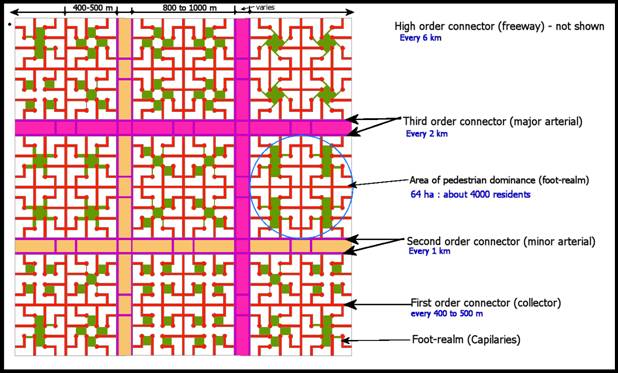
A Fused Grid street uses greenspace to connect cul-de-sac ends, improving connectivity for non-motorized travel (walking and cycling).
Research by the Canada Mortgage and Housing Corporation compared walking mode split in various Puget Sound (Seattle, Washington area) urban neighborhoods (CMHC 2008b). It found the highest proportion of pedestrian trips (18%) in areas where paths are relatively more direct to nearby retail and recreational destinations on foot than by car. Areas with high levels of both pedestrian and vehicle connectivity have about 14% pedestrian mode share, and those with poor pedestrian connectivity have the lowest proportion (10%) of pedestrian trips. These results suggest that the relative connectivity of pedestrian and vehicular modes is an important predictor of the choice to walk. The study found that, all else being equal, compared with conventional urban streets:
· A Fused Grid increases home-based walking trips by 11.3%.
· A Fused Grid is associated with a 25.9% increase in the odds residents will meet the recommended level of physical activity through local walking.
· A 10% increase in relative pedestrian continuity (network density) associates with a 9.5% increase in odds of walking.
· A Fused Grid’s 10% increase in relative connectivity for pedestrians is associated with a 23% decrease in vehicles miles of local travel.
Natural barriers such as rivers, highways and major arterials sometimes create barriers to direct local travel, particularly for non-motorized travel, called the barrier effect or severance (“Barrier Effect,” Litman, 2005). Various design strategies can help improve connectivity across such barriers, including special bridges, decking over major roadways, and creating Pedways, which are walking networks within major commercial centers that connect buildings and transportation terminals (Savvides, 2005).
Efforts to increase roadway connectivity must overcome the common consumer preference for residential cul-de-sac street. Cul-de-sacs are popular because they have limited traffic volumes and speeds, and contribute to a sense of community and security. More connected residential streets can have these attributes if designed with short blocks, “T” intersections, narrower widths and other Traffic Calming features to control vehicle traffic speeds and volumes, and community design features to promote a sense of community and Security. Another objection to a connected street network is that it requires more road right-of-way land, but this can be offset by reducing street widths.
|
Connectivity Index A Connectivity Index can be used to quantify how well a roadway network connects destinations. Indices can be measured separately for motorized and nonmotorized travel, taking into account nonmotorized shortcuts, such as paths that connect cul-de-sacs, and barriers such highways and roads that lack sidewalks. Several different methods can be used.
These indices are affected by how each area is defined, such as whether parklands and industrial areas are included in analysis. It is therefore important to use professional judgment in addition to quantitative measurements when evaluating connectivity. |
Traffic calming sometimes involve changing traffic flow patterns, particularly converting one-way into two-way streets. Analysis by Gilderbloom and Riggs (2015) in several U.S. cities indicates that such conversions:
· Reduce traffic speeds.
· Increase walking and cycling activity.
· Significantly reduce traffic accidents.
· Reduce local crime rates.
· Increase local business activity.
· Increase property values and tax revenues.
An extreme type of unconnected road network is the gated community, a development or neighborhood surrounded by a fence, with access strictly restricted to residents and their guests. This tends to reduce roadway connectivity for residents and others, increasing motor vehicle travel and reducing nonmotorized accessibility (Blakely and Snyder 1995; Burke and Sebaly 2001).
How It Is Implemented
Connectivity can be increased during roadway and pathway planning, when subdivisions are designed, by adopting street connectivity standards or goals, by requiring alleyways and mid-block pedestrian shortcuts, by constructing new roads and paths connecting destinations, by using shorter streets and smaller blocks, and by applying Traffic Calming and Streetscaping rather than closing off streets to control excessive vehicle traffic. New Urbanism development practices and Complete Streets policies emphasize a high degree of street connectivity.
Typical street connectivity standards or goals include the features listed below. Of course, such standards must be flexible to accommodate specific conditions, such as geographic barriers.
- Encourage average intersection spacing for local streets to be 300-400 feet.
- Limits maximum intersection spacing for local streets to about 600 feet.
- Limits maximum intersection spacing for arterial streets to about 1,000 feet.
- Limits maximum spacing between pedestrian/bicycle connections to about 350 feet (that is, it creates mid-block paths and pedestrian shortcuts).
- Reduces street pavement widths to 24-36 feet.
- Limits maximum block size to 5-12 acres.
- Limits or discourages cul-de-sacs (for example, to 20% of streets).
- Limits the maximum length of cul-de-sacs to 200 or 400 feet.
- Limits or discourages gated communities and other restricted access roads.
- Requires multiple access connections between a development and arterial streets.
- Requires a minimum connectivity index, or rewards developments that have a high connectivity index with various incentives.
- Specifically favors pedestrian and cycling connections, and sometime connections for transit and emergency vehicles, where through traffic is closed to general automobile traffic.
- Creates a planning process to connect street “stubs,” that is, streets that are initially cul-de-sacs but can be connected when adjacent parcels are developed in the future.
- Creates Pedways, which are walking networks within major commercial centers that connect buildings and transportation terminals.
Travel Impacts
Increased street connectivity can reduce vehicle travel by reducing travel distances between destinations and by supporting alternative modes. Increased Connectivity tends to Improve Walking and Cycling conditions, particularly where paths provide shortcuts, so walking and cycling are relatively faster than driving. This also supports transit use.
Detailed analysis by Marshall and Garrick (2012) of travel patterns in 24 mid-size California cities found that roadway design factors significantly affect resident’s vehicle travel. The found that per capita vehicle travel tends to:
· Decline with increased total street network density (intersections per square-kilometer).
· Decline with a grid street system (which provides many routes between destinations) compared with a hierarchical systems (which requires traveling on major arterials for a greater portion of trips).
· Decline with on-street parking, bike lanes, and curbs/sidewalks.
· Decline land use density and mix, and proximity to the city center.
· Decline with increased walking, bicycling and transit commute mode share.
· Increase with street connectivity (street link-to-node-ratio, which declines with more dead-end streets).
· Increase with increased major street network density (arterial intersections per square-kilometer).
· Increase with the number of lanes and outside shoulder widths on major roadways.
· Increase with curvilinear streets.
For example, their model indicates that, holding other factors constant, increasing intersection density from 31.3 to 125 intersections per square kilometer is associated with a 41% decrease in vehicle travel, from 44.7 to 26.5 daily vehicle-kilometers.
Ewing and Cervero (2010) find that intersection density and street connectivity has the second greatest impact on travel activity, after regional accessibility, of all land use factors analyzed. They conclude that the elasticity of vehicle travel with respect to connectivity is -0.12, so a 10% increase in intersection or street density reduces vehicle travel 1.2%. Based on detailed reviews of available research Handy, Tal and Boarnet (2010b) conclude that increased street intersection density reduces VMT, and increases walking and public transit travel. They find elasticity values from reliable studies ranging from -0.06 up to -0.59.
Using Bayesian regression models of four U.S. urban region, Zhang, et al. (2012) found that reducing city block length, an indicator of roadway connectivity, had a major effect in reducing per capita VMT, particularly in smaller, less dense, automobile-oriented urban areas (Norfolk-Virginia Beach). The SMARTRAQ Project analysis in Atlanta, Georgia found that doubling the current regional average intersection density, from 8.3 to 16.6 intersections per square kilometer reduces average vehicle mileage by about 1.6%, causing a reduction from about 32.6 to about 32.1 average weekday per capita (16+ years old) vehicle miles in the region, all else held constant. The LUTAQH (Land Use, Transportation, Air Quality and Health) research project sponsored by the Puget Sound Regional Council (www.psrc.org) also found that per household VMT declines with increased street connectivity, all else held constant. That study indicates that a 10% increase in intersections per square mile reduces VMT by about 0.5% (Larry Frank & Company 2005).
Traffic modeling by Alba and Beimborn (2005) finds that improved local street connectivity can reduce traffic volumes, and therefore traffic congestion, on major arterials. Traffic modeling by Kulash, Anglin and Marks (1990) predicts that a connected road network reduces VMT within a neighborhood by 57% compared with conventional designs, although neighborhood travel only represents 5-10% of total vehicle travel, and shorter trip distances may be offset somewhat by increased trips (Crane 1999).
Frank and Hawkins (2007 and 2008) divided neighborhoods into four categories:
- Low permeability for cars, high permeability for pedestrians and cyclists.
- Low permeability for pedestrians and cyclists, high permeability for cars.
- High permeability for both.
- Low permeability for both.
The analysis indicates that the first option significantly increases walking and cycling mode share compared with the others. They estimate that in a typical urban neighborhood, a change from a pure small-block grid to a Fused Grid (pedestrian and cycling travel is allowed, but automobile traffic is blocked at a significant portion of intersections) that increases the relative connectivity for pedestrians 10% typically increases home-based walking trips by 11.3%, increase the odds a person will meet the recommended level of physical activity through walking in their local travel by 26%, and decrease vehicles miles of local travel by 23%.
A USEPA study (2004) found that increased street connectivity, a more pedestrian-friendly environment and shorter route options have a positive impact on performance, (per-capita vehicle travel, congestion delays, traffic accidents and pollution emissions). The Smart Growth Index (USEPA 2002) describes a methodology for calculating the effects of increased roadway connectivity on vehicle trips and vehicle travel. However, current models are not very accurate at predicting how a particular change in roadway connectivity will affect travel patterns. Where other factors are conducive (a neighborhood contains services such as schools and stores, walking conditions are adequate, and there are incentives to use alternative modes), increased roadway connectivity can probably reduce total per capita vehicle mileage by a few percent (Land Use Impacts on Transport).
Table 1 Travel Impact Summary
|
Objective |
Rating |
Comments |
|
Reduces total traffic. |
2 |
Reduces travel distances and therefore VMT. |
|
Reduces peak period traffic. |
1 |
|
|
Shifts peak to off-peak periods. |
0 |
|
|
Shifts automobile travel to alternative modes. |
1 |
Tends to improve walking and cycling. |
|
Improves access, reduces the need for travel. |
3 |
|
|
Increased ridesharing. |
0 |
|
|
Increased public transit. |
0 |
|
|
Increased cycling. |
2 |
|
|
Increased walking. |
3 |
|
|
Increased Telework. |
0 |
|
|
Reduced freight traffic. |
1 |
|
Rating from 3 (very beneficial) to –3 (very harmful). A 0 indicates no impact or mixed impacts.
Benefits and Costs
By improving Accessibility, increasing route options, improving walkability and reducing vehicle travel, improved roadway Connectivity can provide a variety of benefits. Improved Connectivity tends to increase transportation system Resilience by increasing route options, reducing problems when a particular link is closed. It improves emergency response by allowing emergency vehicles more direct access, and reduces the risk that an area will become inaccessible if a particular part of the roadway is blocked by a traffic accident or fallen tree. A more connected street system allows a fire station to serve about three times as much area as in an area with unconnected streets, increases the efficiency and safety of services such as garbage collection and street sweeping (crash rates and insurance costs for such vehicles tend to increase if they are frequently required to back up), and tends to reduce water quality problems that result from stagnant water in dead-end pipes at the end of cul-de-sacs (Handy, Paterson and Butler, 2004, p. 37 and p. 56). These can result in substantial government cost savings or service quality improvements.
Increased road and path connectivity reduces per capita vehicle travel and improves overall accessibility, particularly for non-drivers. It can therefore help reduce traffic congestion, accidents and pollution emissions, and improve mobility for non-drivers. It tends to be particularly effective at achieving TDM objectives where the connectivity of alternative modes is improved more than that of private automobile travel, for example, by providing Pedestrian shortcuts, or implementing Traffic Calming and Vehicle Restrictions to control vehicle traffic.
Marshall and Garrick (2011) conclude that more connected, multi-modal street design can significantly reduce traffic injury and fatality rates in U.S. cities. Wei and Lovegrove (2010) evaluated the road safety of five neighbourhood patterns – grid, culs-de-sac, and Dutch Sustainable Road Safety (SRS, or limited access), 3-way offset, and fused grid networks. Analysis using standard transportation planning methodology revealed that all can maintain similar levels of mobility and accessibility. Analysis using standard road safety analysis methodology further revealed that the 3-way offset, and fused grid patterns significantly improve road safety, by as much as 60% compared to prevalent patterns (i.e. grid and culs-de-sac). These results do not account for the additional safety benefits that result from roadway designs that, by improving non-motorized travel conditions tend to shift travel from auto to non-auto modes. As a result, these can be considered lower-bound estimates of safety benefits.
Costs include additional land and construction requires for additional facilities, increased design requirements, and increased conflicts with adjacent land uses (for example, when a new link is added through an existing property). Increased Connectivity may require lower traffic speeds, since there are shorter links and more intersections. Residential properties tend to have lower values on connected streets than on cul-de-sacs, but this may be offset by incorporating appropriate traffic control and security features into connected streets, as reflected in New Urbanist design practices.
Table 2 Benefit Summary
|
Objective |
Rating |
Comments |
|
Congestion Reduction |
1 |
|
|
Road & Parking Savings |
1 |
|
|
Consumer Savings |
2 |
Reduces travel distances and improves walking and cycling options. |
|
Transport Choice |
2 |
|
|
Road Safety |
1 |
|
|
Environmental Protection |
1 |
|
|
Efficient Land Use |
3 |
|
|
Community Livability |
2 |
|
Rating from 3 (very beneficial) to –3 (very harmful). A 0 indicates no impact or mixed impacts.
Equity Impacts
Improved connectivity tends to help achieve equity impacts to the degree that it improves accessibility and travel options for people who are transportation disadvantaged. In some situations, adding new links to an existing roadway network may cause conflicts and seem unfair to nearby residents.
Table 3 Equity Summary
|
Criteria |
Rating |
Comments |
|
Treats everybody equally. |
0 |
|
|
Individuals bear the costs they impose. |
0 |
|
|
Progressive with respect to income. |
2 |
|
|
Benefits transportation disadvantaged. |
3 |
|
|
Improves basic mobility. |
3 |
|
Rating from 3 (very beneficial) to –3 (very harmful). A 0 indicates no impact or mixed impacts.
Applications
Connectivity improvements can be applied in many situations, and are particularly appropriate for local planners and developers.
Table 4 Application Summary
|
Geographic |
Rating |
Organization |
Rating |
|
Large urban region. |
2 |
Federal government. |
1 |
|
High-density, urban. |
3 |
State/provincial government. |
2 |
|
Medium-density, urban/suburban. |
3 |
Regional government. |
2 |
|
Town. |
3 |
Municipal/local government. |
3 |
|
Low-density, rural. |
1 |
Business Associations/TMA. |
3 |
|
Commercial center. |
3 |
Individual business. |
2 |
|
Residential neighborhood. |
3 |
Developer. |
3 |
|
Resort/recreation area. |
2 |
Neighborhood association. |
3 |
|
College/university communities. |
3 |
Campus. |
2 |
Ratings range from 0 (not appropriate) to 3 (very appropriate).
Category
Land Use Management Strategy.
Relationships With Other TDM Strategies
Roadway Connectivity is an important component of New Urbanism, Smart Growth, and Location-Efficient Development. It supports and is supported by Clustering, Context Sensitive Design, Traffic Calming, Pedestrian and Bicycle Improvements, Road Space Reallocation, and Community Livability.
Stakeholders
Primary stakeholders include local planners, developers, and local residents impacted by changes in roadway and pathway design.
Barriers To Implementation
Increased Connectivity requires roadway and pathway system changes which can be costly and slow to implement, and often involve conflicts with nearby residents who fear increased traffic.
Best Practices
Handy, Paterson and Butler (2004) provide recommendations for improving roadway and pathway connectivity.
- Minimize dead-end streets, and where they exist limit their length to about 200 feet.
- Apply Complete Streets policies that insure that roadway planning and design accommodate diverse users and uses.
- Where dead-end streets exist, try to create paths that provide shortcuts for walking and cycling.
- A modified-grid street network with a high degree of connectivity should generally be used in urban areas.
- As much as possible, new developments and urban redevelopments should have a high degree of roadway and pathway connectivity.
- Use short street and small blocks as much as possible. An ideal for urban development is a 300 to 500 foot grid for pedestrians and bicycles networks and a 500 to 1,000 foot grid for motor vehicle streets.
- Planners should watch for opportunities to increase connectivity, particularly for nonmotorized paths.
- Traffic Calming should generally be used instead of street closures to control excessive vehicle traffic on urban streets.
Examples and Case Studies
Charlotte (NC) Sacks Cul De Sac
Charlotte Observer, October 18, 2003
“The reign of the cul-de-sac ended Wednesday, with a unanimous vote of the Charlotte City Council.” Under a change in the subdivision ordinance, the dead-end circles so common in suburbia can be constructed only when geographic barriers prevent street connections. Though existing cul-de-sacs won’t be affected, the idea, city planners and politicians say, is to alleviate traffic by better linking future communities.
“Charlotte went cul-de-sac happy in the 1970s and 1980s,” said Mayor Pat McCrory. “We failed to develop a grid system of roads and now we have gridlock.” The case against cul-de-sacs is the way they limit access to and from neighborhoods. Frequently, subdivisions of cul-de-sacs have only one or two connections to an adjacent road. When cul-de-sac communities are lined up along that road, it clogs with drivers who have no alternative route. Planners note that traffic flows better in and around neighborhoods such as Myers Park, built in the early 20th century on a grid system that gives drivers more choices.”
Neighborhood Design Affects Walking Activity
A study comparing neighborhood features and travel activity by the Canadian Mortgage and Housing Corporation (CMHC 2008a) found that the highest proportion of pedestrian trips (18%) is found in areas where a path is relatively more direct to nearby retail and recreational destinations on foot than by car. The lowest proportion (10%) of trips occur on foot in places where there is a low degree of pedestrian connectivity. By comparison, places with both high levels of pedestrian and vehicle connectivity have only about 14% mode share on foot. These results suggest that the relative connectivity of pedestrian and vehicular modes is an important predictor of the choice to walk.
Reconnecting Arterials (Savvides 2005)
Savvides (2005) describes how urban path and street connectivity can be improved by using decking of trenched urban arterials, which allows real estate development and connect areas previously separated by the arterial’s right-of-way.
Street Connectivity Standards
Tables 5 and 6 summarize street connectivity standards and requirements in various U.S. cities. See original report for notes and additional information.
Table 5 Street Connectivity Standards (Handy, Paterson and Butler 2004)
|
Location |
Max. Local Street Intersection Spacing (feet) |
Max. Arterial Intersection Spacing (feet) |
Street Stubs Required? |
Cul-De-Sacs Allowed |
Max. Cul-De-Sac Length (feet) |
|
Portland Metro |
530 |
530 |
No |
No (with exceptions) |
200 |
|
City of Portland |
530 |
530 |
Yes |
No (with exceptions) |
200 |
|
Beaverton, Or |
530 |
1,000 |
Yes |
No (with exceptions) |
200 |
|
Eugene |
600 |
none |
Yes |
No (with exceptions) |
400 |
|
Fort Collins, CO |
(Max. Block size 7-12 acres) |
660-1,320 |
Yes |
Limited |
660 |
|
Boulder, Co |
300-350 recommended |
None |
Yes |
Yes, discouraged |
600 |
|
Huntersville, NC |
250-500 |
No data |
Yes |
No (with exceptions) |
350 |
|
Cornelius, NC |
200-1,320 |
|
Yes |
No (with exceptions) |
250 |
|
Conover, NC |
400-1,200 |
No data |
Yes |
Yes |
500 |
|
Raleigh, NC |
1,500 |
No data |
Yes |
Yes |
400-800 |
|
Cary, NC |
Index = 1.2 |
1,250-1,500 |
Yes |
Yes |
900 |
|
Middletown, DE |
Index = 1.7 |
None |
Yes |
Yes, discouraged |
1,000 |
|
Orlando, FL |
Index = 1.7 |
None |
Yes |
Yes |
700 (30 units) |
Table 6 Street Connectivity Requirements (Handy, Paterson and Butler, 2004)
|
Location |
Max. Spacing Between Bike/Ped Connections (feet) |
Local Street Width (feet) |
Private Street Allowed? |
Gated Streets Allowed? |
|
Portland Metro |
330 |
<28 |
Not Regulated |
Not Regulated |
|
City of Portland |
330 |
|
Limited |
No |
|
Beaverton, Or |
330 |
20-34 |
Limited |
No |
|
Eugene |
Connections required at cul-de-sacs |
20-34 |
Limited |
Limited |
|
Fort Collins, CO |
700 |
24-36 |
Limited |
No |
|
Boulder, Co |
300-350 recommended |
24-36 |
No |
No |
|
Huntersville, NC |
None |
18-26 |
No |
No |
|
Cornelius, NC |
None |
18-26 |
Yes |
No |
|
Conover, NC |
None |
22 |
No |
No |
|
Raleigh, NC |
None |
26 |
Discouraged |
Discouraged |
|
Cary, NC |
If index waived |
27 |
yes |
No |
|
Middletown, DE |
No data |
24-32 |
No |
No |
|
Orlando, FL |
None |
24 min. |
Yes |
No |
City of Salem (www.cityofsalem.net)
The City of Salem Design Standards requires that “Local streets should form a well- connected network that provides for safe, direct, and convenient access by automobile, bicycle, and pedestrian.”
Accessible Suburban Multi-Family (Larco 2010)
Nearly a quarter of all suburban housing is multifamily, but such development tends to have poor accessibility due to inadequate connections (sidewalks, paths and roads) to nearby commercial areas, and so fails to reach its potential for reducing automobile travel and increasing active travel. The enclaved nature of most suburban multifamily housing results, in part, from regulatory and planning practices that promote enclaved design. This includes a general lack of specificity in multifamily codes; code-dictated buffers between dissimilar uses; a general lack of street network regulation for multifamily developments; a perception by planners that multifamily housing should primarily act as a buffer between commercial and single-family uses; a general un-welcoming attitude towards this development type; and a general lack of attention given to this housing typology.
Analysis of residents travel patterns indicate that residents of suburban multi-family developments are relatively high users of alternative modes: Data from the National American Housing Survey indicate that suburban multifamily residents are more than three times more likely than single-family residents to walk or bike to work (3.5% vs. 1.1%), four times more likely to use transit to work (6.6% vs.1.5%), and twice as likely to carpool to work (15.2% vs. 7.3%). A survey of resident indicated latent demand for nonmotorized access to local services: 77% report that they would walk and/or bike to local stores and restaurants if they were easier to reach. Respondents in the more-connected development were more than twice as likely to walk and/or bike to local amenities, with 87% and 70% reporting that they did so. In addition, respondents from the less-connected developments reported the ease and/or safety of a potential walking and/or biking trip as the largest barrier to their walking and/or biking.
A variety of policy and planning reforms can improve suburban accessibility, by creating specific street connectivity standards, promoting parking designs that shift away from large parking lots and towards smaller parking pods, and promoting a robust pedestrian network within multifamily developments that facilitates trips not only from a car to a unit, but also within the development and to adjacent destinations.
Portland Regional Connectivity Policies (www.metro-region.org/library_docs/trans/streetconnect.pdf)
The Portland Regional Transportation Plan includes specific policies to increase roadway connectivity in new developments, as well as various strategies to improve the connectivity of nonmotorized networks in existing urbanized areas.
Bremen, Germany (Glotz-Richter, 2003)
In the early 1960s, the city of Bremen was divided into four sectors, or “traffic cells.” Automobiles are allowed to travel within each cell, but to travel between these cells they must use a circumferential ring road. Pedestrian, bicycle and transit vehicles can travel directly between these cells. As a result, vehicle traffic volumes are significantly reduced and travel by other modes is significantly improved.
Gothenburg, Sweden (Vuchic 1999)
The city of Gothenburg is Sweden’s second largest city, with almost half a million residents. In the late 1960s, the city’s historic center was divided into five traffic cells. Automobiles can travel within each cell but not directly between cells, they must use a ring road. Pedestrian, bicycle and transit vehicles can travel directly between cells. The result has been a 48% reduction in vehicle traffic despite increased vehicle ownership by residents, improved pedestrian and cycling conditions (and a 45% reduction in pedestrian accidents), and improved transit service.
References And Resources For More Information
Carlos A. Alba and Edward Beimborn (2005), Analysis of The Effects Of Local Street Connectivity On Arterial Traffic, Transportation Research Board Annual Meeting (www.trb.org); at www.uwm.edu/Dept/CUTS//lu/conn.pdf.
Edward J. Blakely and Mary Gail Snyder (1995), “Fortress Communities: The Walling and Gating of American Suburbs,” LandLines, Vol. 7, No. 5, Lincoln Institute for Land Policy (www.lincolninst.edu); at www.lincolninst.edu/pubs/537_Fortress-Communities---The-Walling-and-Gating-of-American-Suburbs.
Matthew Burke and Christian Sebaly (2001), “Locking in the Pedestrians? The Privatized Streets of Gated Communities,” World Transport Policy & Practice (www.eco-logica.co.uk/wtpp07.4.pdf), Vol. 7, No. 4, pp. 67-74.
Calgary (2008a), Local Transportation Connectivity Study, Plan-It Calgary, City of Calgary (www.calgary.ca); at www.calgary.ca/docgallery/BU/planning/pdf/plan_it/connectivity_study_december.pdf.
CMHC (2008b), Giving Pedestrians an Edge—Using Street Layout to Influence Transportation Choice, Canada Mortgage and Housing Corporation (www.cmhc-schl.gc.ca); at www.cmhc-schl.gc.ca/odpub/pdf/66086.pdf.
CMHC (2008c), Taming the Flow — Better Traffic and Safer Neighbourhoods, Canadian Mortgage and Housing Corporation (www03.cmhc-schl.gc.ca); at www.fusedgrid.ca/docs/TamingtheFlow.pdf.
Complete Streets (www.completestreets.org)
is a campaign to promote roadway designs that effectively accommodate multiple
modes and support local planning objectives.
Paul Cozens and David Hillier (2008), “The Shape of Things to Come: New Urbanism, the Grid and the Cul-De-Sac,” International Planning Studies, 13(1), pp. 51; at http://bit.ly/22iUMzC.
Randall Crane (1999), The Impacts of Urban Form on Travel: A Critical Review, Working Paper WP99RC1, Lincoln Institute for Land Policy (www.lincolninst.edu).
Jennifer Dill (2005), Measuring Network Connectivity for Bicycling and Walking, School of Urban Studies and Planning, Portland State University (http://web.pdx.edu/~jdill).
Reid Ewing (1996), Best Development Practices; Doing the Right Thing and Making Money at the Same Time, Planners Press (www.planning.org), 1996.
Reid Ewing and Robert Cervero (2010), “Travel and the Built Environment: A Meta-Analysis,” Journal of the American Planning Association, Vol. 76, No. 3, Summer, pp. 265-294; at http://pdfserve.informaworld.com/287357__922131982.pdf.
Lawrence Frank and Chris Hawkins (2007), Fused Grid Assessment: Travel And Environmental Impacts Of Contrasting Pedestrian And Vehicular Connectivity, Canada Mortgage and Housing Corporation (www.cmhc-schl.gc.ca).
Lawrence Frank and Chris Hawkins (2008), Giving Pedestrians an Edge—Using Street Layout to Influence Transportation Choice, Canada Mortgage and Housing Corporation (www.cmhc-schl.gc.ca); at www.cmhc-schl.gc.ca/odpub/pdf/66086.pdf.
Fused Grid Website (www.fusedgrid.ca). This website provides information and examples of Fused Grid roadway designs.
Vikash V. Gayah and Carlos F. Daganzo (2012), “Analytical Capacity Comparison of One-Way and Two-Way Signalized Street Networks,” Transportation Research Record 2301, Transportation Research Board (www.trb.org), pp. 76-85; summarized in “Two-Way Street Networks: More Efficient than Previously Thought?” Access 41, Fall, pp. 10-15; at www.uctc.net/access/41/access41.pdf.
David J. Giacomin and David M. Levinson (2015), “Road Network Circuity in Metropolitan Areas,” Environment and Planning B, Vol. 42, No. 6, pp. 1040-1053; summary at http://transportationist.org/2016/01/07/road-network-circuity-in-metropolitan-areas.
John Gilderbloom and William Riggs (2015), “Two-Way Street Conversion Evidence of Increased Livability in Louisville,” Journal of Planning Education and Research, DOI: 10.1177/0739456X15593147; at http://bit.ly/1JfQ3Vx and summarized in www.planetizen.com/node/80428/americas-streets-two-ways-urban-regeneration.
Michael Glotz-Richter (2003), Moving the City: A Guided Tour of the Transport Integration Strategy in Bremen, Germany, Moving the Economy’s New Mobility Industry Forum (http://213.170.188.3/moses/m_papers/video_summary.pdf).
Fanis Grammenos (2004), “Fused Grid: A New Model for Sustainable – And Livable – Development,” Municipal World (www.municipalworld.com), July 2004, pp. 11-12, 54-55; at www.cmhc-schl.gc.ca/en/inpr/su/sucopl/fugr/index.cfm.
Fanis Grammenos and Gordon Lovegrove (2015), Remaking the City Street Grid – A Model for Urban and Suburban Development, McFarland Publishers (www.mcfarlandbooks.com/book-2.php?id=978-0-7864-9604-4).
Susan Handy, Robert G. Paterson and Kent Butler (2004), Planning for Street Connectivity: Getting From Here to There, Planning Advisory Service Report 515, American Planning Association (www.planning.org).
Susan Handy, Gil Tal and Marlon G. Boarnet (2010), Draft Policy Brief on the Impacts of Network Connectivity Based on a Review of the Empirical Literature, for Research on Impacts of Transportation and Land Use-Related Policies, California Air Resources Board (http://arb.ca.gov/cc/sb375/policies/policies.htm).
Brian Jones (2016), You Can Connect Communities! Think Creatively & Be Collaborative, www.linkedin.com/pulse/you-can-connect-communitiesthink-creatively-bryan-jones-pe-aicp.
Walter Kulash, Joe Anglin and David Marks (1990), “Traditional Neighborhood Development: Will the Traffic Work?” Development 21, July/August 1990, pp. 21-24.
Philip Langdon (2004), “‘Street Connectivity’ Emerging As A New Municipal Goal,” New Urban News, New Urban Publications (www.newurbannews.com), June 2004, pp. 1-6.
Nico Larco (2010), Overlooked Density: Re-Thinking Transportation Options In Suburbia, OTREC-RR-10-03, Oregon Transportation Research and Education Consortium (www.otrec.us); at www.otrec.us/main/document.php?doc_id=1238.
Larry Frank & Company (2005), A Study of Land Use, Transportation, Air Quality and Health in King County, WA, King County; at http://your.kingcounty.gov/healthscape/publications/LUTAQH_final_report.pdf.
Todd Litman (2005), Transportation Cost and Benefit Analysis, Victoria Transport Policy Institute (www.vtpi.org/tca).
Todd Litman (2008), Evaluating Accessibility for Transportation Planning, Victoria Transport Policy Institute (www.vtpi.org); at www.vtpi.org/access.pdf .
Todd Litman (2013), Evaluating Complete Streets: The Value of Designing Roads For Diverse Modes, Users and Activities, Victoria Transport Policy Institute (www.vtpi.org); at www.vtpi.org/compstr.pdf.
Todd Litman (2015), Comprehensive Evaluation of Completes Streets Policies: The Value of Designing Roads For Diverse Modes, Users and Activities, presented at the Threadbo 14 Conference (www.thredbo-conference-series.org), August 2015, Santiago, Chile; at www.vtpi.org/compstr.pdf.
Gordon Lovegrove and James Sun (2009), Research Study On: Evaluating The Level Of Safety Of The Fused Grid Road Pattern, School of Engineering, UBC Okanagan for the Canada Mortgage and Housing Corporation (www.cmhc-schl.gc.ca).
Wesley E. Marshall and Norman W. Garrick (2011), “Evidence on Why Bike-Friendly Cities Are Safer for All Road Users,” Environmental Practice, Vol 13/1, March; at http://files.meetup.com/1468133/Evidence%20on%20Why%20Bike-Friendly.pdf.
Wesley E. Marshall and Norman W. Garrick (2012), “Community Design And How Much We Drive, Journal of Transport and Land Use, Vol. 5, No. 2, pp. 5–21, doi: 10.5198/jtlu.v5i2.301; at www.jtlu.org/index.php/jtlu/article/view/301/246.
Portland Metro (2001), “Street Connectivity Standards,” Planning for Future Streets: Implementing the Regional Transportation Plan, Portland Metro Regional Services (www.metro-region.org/library_docs/trans/streetconnect.pdf).
Portland Metro (2004), Street Connectivity: An Evaluation of Case Studies in the Portland Region, Portland Metro (www.metro-region.org); at http://library.oregonmetro.gov/files/connectivityreport.pdf.
Andreas L. Savvides (2005), Bridging The Urban Arterial The Premium For Reconnecting The Urban Fabric, Transportation Research Board Annual Meeting (www.trb.org).
R. J. Smeed (1963), “The Effect Of Some Kinds Of Routeing Systems On The Amount Of Traffic In The Central Areas Of Towns, Journal of the Institute of Highway Engineers, Vol. 10, No. 1, 1963, pp. 5-26.
Ali Soltani and Andrew Allan (2005), A Computer Methodology For Evaluating Urban Areas For Walking, Cycling And Transit Suitability: Four Case Studies From Suburban Adelaide, Australia, Paper 272, Computers in Urban Planning and Urban Management (http://128.40.111.250/cupum/searchpapers/index.asp); at http://128.40.111.250/cupum/searchpapers/papers/paper272.pdf.
TGM (2003), Connecting Transportation and Land Use: Street Connectivity, Information Brief, Transportation and Growth Management, Portland Metro (http://darkwing.uoregon.edu/~cpw/projects/pdf/featured/tgm_2003/educational%20materials/Street%20Connectivity_Brief.pdf).
USEPA (2002), Smart Growth Index (SGI) Model, U.S. Environmental Protection Agency (www.epa.gov/smartgrowth/topics/sgipilot.htm), 2002. For technical information see Criterion, Smart Growth Index Indicator Dictionary, U.S. Environmental Protection Agency (www.epa.gov/smartgrowth/pdf/4_Indicator_Dictionary_026.pdf).
USEPA (2004), Characteristics and Performance of Regional Transportation Systems, Smart Growth Program, US Environmental Protection Agency (www.epa.gov/smartgrowth/performance2004final.pdf).
Vukan R. Vuchic (1999), Transportation for Livable Cities, CUPR Press (www.policy.rutgers.edu/cupr).
Vicky Feng Wei and Gord Lovegrove (2010), “Sustainable Road Safety: A New (?) Neighbourhood Road Pattern That Saves VRU (Vulnerable Road Users) Lives,” Accident Analysis & Prevention (www.sciencedirect.com/science/journal/00014575).
Ania Wieckowski (2010), “The Unintended Consequences of Cul-de-sacs,” Harvard Business Review (http://hbr.org); at http://hbr.org/2010/05/back-to-the-city/sb1.
WSDOT (2011), Variations on the Grid, Washington State Department of Transportation (www.wsdot.wa.gov); at www.wsdot.wa.gov/LocalPrograms/Planning/TheGrid.htm.
Yuanyuan Zhang, et al. (2012), Associations Between Road Network Connectivity and Pedestrian-Bicyclist Accidents, TRB Annual Meeting, SafeTREC (www.safetrec.berkeley.edu); at www.safetrec.berkeley.edu/trb2012/Zhang_Bigham_etal_TRB12-0478.pdf.
Lei Zhang, et al. (2012), How Built-Environment Affect Travel Behavior: A Comparative Analysis of Travel Behavior and Land Use in U.S. Cities, Journal of Transport and Land Use (http://jtlu.org), Vol. 5, No. 3, pp. 40-52; at www.jtlu.org/index.php/jtlu/article/view/266/268.
This Encyclopedia is produced by the Victoria Transport Policy Institute to help improve understanding of Transportation Demand Management. It is an ongoing project. Please send us your comments and suggestions for improvement.
Victoria Transport Policy Institute
www.vtpi.org info@vtpi.org
1250 Rudlin Street, Victoria, BC, V8V 3R7, CANADA
Phone & Fax 250-360-1560
“Efficiency - Equity - Clarity”
#116