Location Efficient Development and Mortgages
Taking Advantage of Consumer and Transportation Benefits at Accessible Locations
~~~~~~~~~~~~~~
Victoria Transport Policy Institute
~~~~~~~~~~~~~~~~~~~~
Updated 18 July 2017
This chapter describes Location Efficient Development, which consists of residential and commercial development located and designed to maximize accessibility and overall affordability, and Location Efficient Mortgages, which recognize the cost savings to households that choose more accessible locations, allowing them additional borrowing ability.
Description
Location Efficient Development consists of residential and commercial development located and designed to maximize Accessibility and overall Affordability. This usually means that it is close to good transit service and public services, has good walking and cycling conditions and other features that reduce Automobile Dependency. It often involves urban infill, such as projects to redevelop inner-city neighborhoods or converting older industrial buildings to loft apartments. Location Efficient Development can also include efforts to cluster activities and services together into Commercial Centers, and to redevelop older downtowns. Residents and employees in such areas tend to drive less, rely more on alternative forms of transportation, and enjoy better transportation options than those who live or work in less accessible areas.
Per-household transportation expenditures tend to be lower for residents in such areas. Residents of cities with high levels of transit ridership tend to spend significantly less per capita on transportation than residents of more automobile-dependent cities (Litman, 2006), as illustrated below. Similarly, McCann (2000) found that households in more automobile-dependent communities on average spend more than 20% of household budgets on transportation (over $8,500 annually), while those in communities with more diverse transportation systems spend less than 17% (less than $5,500 annually), representing thousands of dollars in annual savings (McCann 2000).
Figure 1 Percent Transport Expenditures (Litman 2006)
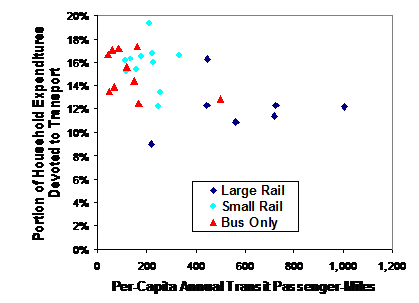
The portion of total household expenditures devoted to transportation (automobiles and transit) tends to decline with increased per-capita transit ridership.
Studies comparing housing and transportation costs in typical urban areas find that although average household expenditures on housing are similar in different geographic locations, transportation expenditures are much higher in outer suburbs and exurban areas than in inner suburbs and cities (ULI 2009), as illustrated in Figure 2. According to this study, transportation costs average 19% of household expenditures overall, but range from about 10% in multi-modal communities up to about 25% in automobile dependent communities. To the degree that Smart Growth reduces household transportation costs it can increase overall affordability and offsets any increased housing costs, which can be considered comparable to additional household income.
Figure 2 Affordability Index (CTOD and CNT 2006)

Transportation expenditures are much higher in outer suburbs and exurban areas than in inner suburbs and cities, reducing overall affordability.
Location Efficiency tends to improve households’ economic resilience, that is, they are better able to respond to unexpected financial burdens such as fuel price increases, vehicle failures or income losses, and so it reduces housing foreclosures. According to the Location Efficiency and Mortgage Default study, the probability of mortgage foreclosure increases as neighborhood vehicle ownership levels rise, after controlling for income (NRDC 2010). These results suggest that public policies that support location efficiency can help to reduce mortgage foreclosures, and that loans are safer for housing in more multi-modal locations.
As fuel prices have increased, so has the value of urban locations, while automobile-dependent locations tend to lose value (Cortright 2008). A typical middle-income U.S. household spent about $2,000 annually for vehicle fuel in 2003, when gasoline prices averaged about $1.50 per gallon, and so would need to spend about $5,000 annually to maintain the same amount of mobility in 2008 when fuel prices reached about $4.00 per gallon. A more accessible location with lower vehicle travel requirements can save such households about $2,500 annually in fuel costs, making it cost effective to pay up to $700,000 in additional house purchase costs at 7% interest.
Various policy reforms can help increase Affordability while also reducing per capita automobile use and encouraging more efficient land use (Litman 2006; ULI 2009; Pollack, Bluestone and Billingham 2010). Parking Management can reduce residential parking requirements, particularly in multi-modal, urban neighborhoods (Litman 2004; CNU 2008). Smart Growth Market Reforms include a variety of strategies that reduce development and utility costs for urban homes. Many features of Smart Growth and New Urbanism, such as small lot development, zero lot lines, mixed housing types and housing above commercial development can reduce housing costs and increase housing options. The city of Austin, Texas imposes a transportation user fee for roads which exempts residents that do not own an automobile, as described in the Case Study section.
Concurrency requirements imposed in some jurisdictions limit development based on the projected capacity of available infrastructure, including roadway capacity. For example, developers might be required to pay for roadway expansion if a project is projected to increase traffic so that local road Level-of-Service degrades from C to D. This tends to discourage infill development and encourage dispersed, automobile-dependent sprawl. Revised concurrency requirements take into account the reduced per capita traffic generation, shorter trips and improved travel options in urban areas, and so allow more infill development (Wallace 2005).
Location Efficient Mortgages (LEMs) means that lenders recognize these potential savings of a more accessible housing location when assessing a household’s borrowing ability. It considers transportation and housing costs together, so vehicle cost savings are treated as additional income that can be spent on a mortgage. This gives homebuyers an added incentive to choose location efficient residences, and tends to encourage more infill development as opposed to more automobile-dependent development at the urban periphery (Hare 1995; Hoeveler 1997). Location Efficient Development and Mortgages tend to benefit lower-income households by providing financial savings and improving affordable transport and housing options.
Consumer expenditures on motor vehicles provide little durable economic value (McCann 2000). $10,000 spent on motor vehicles provides just $910 in long-term equity, compared with $4,730 for the same investment in housing. This suggests that shifting consumer expenditures from motor vehicles to other investments, such as housing, education or savings, tends to increase household wealth.
|
Smart Growth and Housing Affordability Smart Growth policies such as urban growth boundaries and development fees can increase development costs, reduce housing Affordability, creating social problems and increasing vehicle traffic if it causes employees to live far from where they work. However, these impacts are often exaggerated by critics of Smart Growth: a reduction in the supply of greenfield land available for development is only one of many factors that affect housing affordability (Land Use Evaluation). Other factors include: · Land devoted to lawns and gardens · Building type (single versus multi-story) · Housing size · Land devoted to parking and roads · Amount of public space (parks)
For example, if land prices increase households may choose smaller lawns and gardens, shift from a single-story to a multi-story home, reducing the amount of land devoted to driveways and parking, and use shared greenspace (for example, choosing a home near public parks).
Although some consumers have very strong housing preferences (it may be difficult to persuade some people to live in an urban apartment), consumers often have a wide range of options at the margin. For example, some households may prefer a single-family home with a large garden, but would be willing to accept a smaller garden or attached home in exchange for other amenities such as a desirable location, lower tax and utility rates, nearby parks and attractive neighborhood design. Tax rates, utility costs, transportation costs and the quality of public services, walking and cycling conditions, transit service quality, and parking costs may all affect such decisions.
It is therefore wrong to assume that a reduction in housing parcel size reduces consumer benefits if it results in part from positive incentives (e.g., cost savings to those who use less land or reduce their vehicle mileage) and consumers have viable choices. In such conditions, the consumers who place a higher value on space and mobility will continue with their current land use patterns, but those who place relatively less value on these goods have a new opportunity to capture benefits. |
How it is Implemented
Location Efficient Development is implemented by developers, usually with support and encouragement from local governments. It is often implemented as part of Smart Growth and New Urbanist planning. Transit Oriented Development can be a catalyst for Location Efficient Development (CTOD 2006; FTA 2008).
Location Efficient Mortgages are implemented by residential mortgage lenders, often with the support and encouragement of government agencies such as Fannie Mae and the Canadian Mortgage and Housing Corporation. Lenders use a model to determine which locations have lower transportation costs, and therefore can qualify for higher mortgage payments. The following factors can be considered in such models:
1. Proximity to high quality Transit Service (such as a rail transit station, or a bus line with frequent service).
2. Transit Station Improvements.
3. Walking and Cycling conditions.
4. Number of public services within convenient walking distance (schools, shops, parks, medical services, pharmacy, etc.).
5. Carshare services within convenient walking distance.
6. Parking Management (unbundled parking, so residents who do not own an automobile are not forced to pay for parking).
The following criteria can be used to evaluate Location Efficient Development:
· Is it located in an urban area within a half-mile of quality public transit?
· Does it include, or is it located near, commonly-used public services such as grocery stores, video stores and public schools.
· Will it reduce dependency on automobiles?
· Does it have a minimum density of 20 units per acre?
· Does it have at least 20 units?
· Is it reflect good design features?
· Is it being developed with substantial community input?
· Does it include a significant portion of affordable housing units?
Travel Impacts
Per capita automobile travel is often 20-50% lower in Location Efficient Developments than in automobile-dependent, urban fringe locations (Litman 2008). Table 1 summarizes the projected VMT reduction impacts of various Location-Efficient, infill developments.
Table 1 Infill VMT Reductions (CCAP 2003)
|
Location |
Description |
VMT Reduction |
|
Atlanta |
138-acre brownfield, mixed-use project. |
15-52% |
|
Baltimore |
400 housing units and 800 jobs on waterfront infill project. |
55% |
|
Dallas |
400 housing units and 1,500 jobs located 0.1 miles from Dallas Area Rapid Transit (DART) station. |
38% |
|
Montgomery County |
Infill site near major transit center |
42% |
|
San Diego |
Infill development project |
52% |
|
West Palm Beach |
Auto-dependent infill project |
39% |
Actual travel impacts may vary depending on household preferences and demographics, neighborhood conditions, and travel choices (Land Use Impacts on Transport). Travel reductions are greatest if Location Efficient Housing attracts residents who would otherwise choose more automobile-dependent lifestyles.
Table 2 Travel Impact Summary
|
Objective |
Rating |
Comments |
|
Reduces total traffic. |
3 |
Reduces per capita driving. |
|
Reduces peak period traffic. |
2 |
|
|
Shifts peak to off-peak periods. |
0 |
|
|
Shifts automobile travel to alternative modes. |
3 |
Encourages use of alternative modes. |
|
Improves access, reduces the need for travel. |
3 |
Encourages more accessible residential locations. |
|
Increased ridesharing. |
1 |
|
|
Increased public transit. |
3 |
Supports transit use. |
|
Increased cycling. |
2 |
Supports cycling. |
|
Increased walking. |
3 |
Supports walking. |
|
Increased Telework. |
0 |
|
|
Reduced freight traffic. |
0 |
|
Rating from 3 (very beneficial) to –3 (very harmful). A 0 indicates no impact or mixed impacts.
Benefits and Costs
Location Efficient Development and mortgages can provide several benefits:
· Consumers benefit from improved housing and transportation Options and Affordability. Non-drivers in particular benefit from having housing options designed for maximum accessibility, and financial savings from reduced transportation and parking costs.
· Developers can benefit from having more design flexibility, including more opportunities for infill development, reduced parking costs, and because LEMs increase the amount a household can spend on housing. It creates new markets and financing options.
· Urban neighborhoods can benefit from more opportunities for middle-class infill development, fewer motor vehicles, and less vehicle traffic. It tends to increase community Livability.
· Mortgage default rates tend to be lower in location-efficient neighborhoods, indicating that households are better able to respond to unexpected financial burdens such as fuel price increases, vehicle failures or income losses (NRDC 2010; Pivo 2013; Rauterkus, Thrall and Hangen 2010).
· By reducing per capita vehicle ownership use, Location Efficient Development can reduce regional traffic congestion, road and parking facility costs, traffic crashes, pollution and sprawl.
· Location efficient development can provide substantial energy savings and pollution emission reductions. According to one study, Location Efficient Development could reduce total U.S. energy consumption by about 10% after a decade (Burer, Goldstein and Holtzclaw (2004).
· Regional economies tend to benefit when consumers shift their transportation expenditures from vehicles and fuel to transit services or general consumer goods (TDM and Economic Development).
There may be costs associated with higher population density in urban neighborhoods (see discussion in the Land Use Impacts on Transport chapter, and in Litman, 2000). Some households that choose location efficient housing that has limited parking may eventually purchase additional motor vehicles, if their needs change or they become wealthier, thus increasing local traffic and parking problems. This may require Parking Management. Some location efficient housing includes resident covenants that restrict vehicle ownership. Urban infill may also cause displacement of lower-income households (“gentrification”). There may also be transition costs to mortgage institutions and local planning agencies for changing their practices.
Table 3 Benefit Summary
|
Objective |
Rating |
Comments |
|
Congestion Reduction |
2 |
Reduces per-household automobile travel in higher-density areas. |
|
Road & Parking Savings |
3 |
Reduces per-household automobile travel. |
|
Consumer Savings |
3 |
Increases housing affordability. Reduces vehicle and parking costs. |
|
Transport Choice |
3 |
Improves consumer housing and transport choices. |
|
Road Safety |
2 |
Reduces per-household automobile travel. |
|
Environmental Protection |
3 |
Reduces per-household automobile ownership and use, and reduces sprawl. |
|
Efficient Land Use |
3 |
Encourages higher-density location choice. |
|
Community Livability |
3 |
Encourages urban infill by middle-class families, reduced car ownership and use. |
Rating from 3 (very beneficial) to –3 (very harmful). A 0 indicates no impact or mixed impacts.
Equity Impacts
Location efficient housing and mortgages tend to increase equity by allowing households that own fewer than average automobiles to avoid paying for parking they don’t use, and by increasing housing options for lower-income households and non-drivers (CNU, 2008). Residential parking requirements reflect suburban, middle-class car ownership rates that are excessive for many households, particularly those with lower incomes. This is both unfair and regressive. Location Efficient Development is optional, so consumers will only choose it if they consider themselves better off overall.
Table 4 Equity Summary
|
Criteria |
Rating |
Comments |
|
Treats everybody equally. |
2 |
Fairer treatment of urban homebuyers. |
|
Individuals bear the costs they impose. |
3 |
Allows reduction in parking subsidies. |
|
Progressive with respect to income. |
3 |
Significantly benefits lower-income households. |
|
Benefits transportation disadvantaged. |
3 |
Significantly benefits non-driving households. |
|
Improves basic mobility. |
2 |
Improves access to shops, schools, employment, etc., particularly for non-drivers. |
Rating from 3 (very beneficial) to –3 (very harmful). A 0 indicates no impact or mixed impacts.
Applications
Location Efficient Development is most appropriate in urban neighborhoods that have good access (services and activities are easily available by walking and transit). It can be implemented by regional or local governments, or by non-profit organizations or individual businesses.
Table 5 Application Summary
|
Geographic |
Rating |
Organization |
Rating |
|
Large urban region. |
3 |
Federal government. |
2 |
|
High-density, urban. |
3 |
State/provincial government. |
2 |
|
Medium-density, urban/suburban. |
2 |
Regional government. |
3 |
|
Town. |
3 |
Municipal/local government. |
3 |
|
Low-density, rural. |
1 |
Business Associations/TMA. |
2 |
|
Commercial center. |
3 |
Individual business. |
2 |
|
Residential neighborhood. |
3 |
Developer. |
3 |
|
Resort/recreation area. |
3 |
Neighborhood association. |
3 |
|
|
|
Campus. |
3 |
Ratings range from 0 (not appropriate) to 3 (very appropriate).
Category
Institutional Reform and Land Use Management
Relationships With Other TDM Strategies
LEM is most effective as part of comprehensive Smart Growth, New Urbanist, Transit Oriented Development and Access Management efforts to encourage multi-modal, mixed-use, infill development. Smart Growth Policy Reforms are often important for implementation. It supports and is supported by Pedestrian and Cycling Improvements, Transit Improvements, Parking Management and Carsharing. Carfree Development is generally location efficient. In some situations it may be helpful to Address Security Concerns to encourage more Location Efficient Development in existing urban neighborhoods.
Stakeholders
Developers, planners, local officials, local businesses and residents of existing urban neighborhoods can all be involved in implementing Location Efficient Development. LEM requires changes in practices by lenders (banks and other mortgage lenders), the real estate industry, and local governments, particularly by making parking requirements more flexible.
Barriers To Implementation
Location Efficient Development and Mortgages require overcoming various types of resistance in the mortgage, real estate and local planning institutions. Pilot projects, case studies, and professional education workshops may be helpful in propagating these concepts.
Best Practices
Here are some specific recommendations for implementing Location Efficient Development and Mortgages (Arigoni 2001).
· Location Efficient Development should include a variety of land use and transportation features that improve access and mobility options, including pedestrian and cycling improvements, transit improvements, and mixed land use.
· Location Efficient Development should include a range of housing types and prices, so that people in various lifecycle stages and income classes can choose such housing.
· Parking requirements should be reduced or eliminated for location efficient housing. Rather than including parking with housing, parking should be rented separately, so households only pay for the amount of parking they actually use.
· Parking should be managed to avoid spillover problems.
|
Why do chicken coops only have 2 doors? If they had 4 doors they would be chicken sedans. |
Examples and Case Studies
Fannie May LEM Programs (www.fanniemae.com)
Fannie Mae, the largest source of home loan funds in the USA, is supporting the development of LEMs. Seattle and the Bay Area of California were the first areas of the country targeted for participation.
“Program’s goal is more homeowners and fewer drivers, The Fannie Mae Foundation and the city of Seattle are teaming up to get people out of their cars and into homes.”
Wall Street Journal article, By Sam Bennett, 2000.
Mayor Paul Schell on Tuesday introduced the Location Efficient Mortgage Initiative, a program that increases homebuyers’ purchasing power in return for abandoning their cars and using mass transit (www.cityofseattle.net/housing/02-LookingForHousing/LocationEfficientMortgage.htm). The pilot program, the first of its kind in the U.S., soon will be launched in Los Angeles, San Francisco and Chicago.
“We’re in the American Dream business,” said Heyward Watson, director of Fannie Mae’s Puget Sound office. It’s a well-known fact, however, that attaining that dream in Seattle and King County has become increasingly more difficult.
Since 1990, the median cost of a house in Seattle has risen from $138,000 to $223,000, and countywide the median price has increased from $140,000 to $215,000. According to county statistics released Tuesday, homebuyers making 80 percent of median income -- about $48,560 for a two-person household -- could afford only 8.5 percent of the single-family homes available in the county last spring.
To give Seattle homebuyers more leverage, the Location Efficient Mortgage Initiative rewards homebuyers with larger loans than they normally would qualify for and lower downpayments. In return, Fannie Mae and the city will request that participants own one car or less per household and live within a quarter mile of a bus line or half a mile from a train or light rail system. The initiative will also offer discounted annual bus passes for one member of the household. “We want to encourage home ownership and fewer trips in the car,” Schell said. “As Seattle’s housing prices escalate, we need to be creative to encourage affordability.”
The program works by assigning values to each Seattle home based on residential density, amenities such as shopping, and access to public transportation. Homes in neighborhoods with fewer amenities and less access to public transportation would be assigned a lower “location efficient value” than areas such as Belltown or the University District, which have more amenities and greater transportation access. The program would also apply to condominiums.
A family earning $60,000 a year would qualify, under traditional mortgage underwriting guidelines, for a $143,000 home. But if the family gives up one car, their annual savings would be $3,200, according to a city-commissioned study.
Because of that savings, Continental Savings Bank would extend the family’s credit by $17,800 toward the purchase price of a $160,700 home. The study says that expenses that would normally go toward a vehicle can be re-directed toward the mortgage.
For Jackie Peyton, the first person to be approved for the program, buying a home or condo is now within reach. “I was relieved because as I was looking at the prices I realized I would probably have to move out of the city,” she said. “With this new loan, I have more buying power in the city.”
Homeownership is also a critical issue, Schell said. The county has a 59 percent rate of homeownership, a figure that has stayed the same for nine years. In Seattle, the homeownership rate is even lower, at 48 percent -- well below the national average of 66 percent.
“I do know that there is a pent-up demand for people to be able to qualify for a loan to buy a house,” said Cynthia Parker, director of Seattle’s Office of Housing. “This is a way for us to get more homeownership in Seattle.”
For homebuyers like Peyton, participating in the program means foregoing the headaches of commuting by either walking to work from a downtown condo or taking a bus from a nearby neighborhood. “I’m getting over the idea of living in the suburbs because I can get more house out there,” she said. “Sitting, idling in traffic in a car takes its toll.”
Relocation Support System (Sriraj, Minor and Thakuriah, 2006)
An Internet-based Spatial Decision Support System (SDSS) developed at the University Of Illinois gives households detailed information on various factors for use when choosing a neighborhood when relocating, including accessibility factors such as travel time and costs by various modes.
|
Housing + Transportation Affordability Index (http://htaindex.cnt.org) The Housing + Transportation Affordability Index, developed by the Center for Neighborhood Technology (CNT) and the Center for Transit Oriented Development (CTOD), is an innovative tool that measures true housing affordability. Planners, lenders, and most consumers traditionally measure housing affordability as 30% or less of income. The Housing + Transportation Affordability Index takes into account not just the cost of housing, but also the intrinsic value of place, as quantified through transportation costs.
This work is a project of the Brookings Institution's Urban Markets Initiative and is the most comprehensive study-to-date of the Housing + Transportation Affordability Index. That study found that the three primary dependent variables in the household transportation model are auto ownership, auto use and transit ridership and that the two primary independent variables are residential density and household income. The second phase of the project models neighborhood-level data for 52 different metropolitan areas with results available through an interactive mapping website. |
GreenTRIP (www.GreenTRIP.org)
GreenTRIP is an innovative certification program that rewards residential infill projects that apply comprehensive transport management strategies to reduce traffic, energy consumption and pollution emissions. Designed to complement LEED certification, which focuses on building design, GreenTRIP measures how connected a community is and what resources and incentives are provided to help use alternative transport modes, including walking, cycling, ridesharing, public transit and carsharing.
GreenTRIP certifies developments located in walkable neighborhoods near high quality public transit services that apply traffic-reducing strategies such as unbundled parking, carshare memberships, and discounted transit passes. These amenities tend to pay for themselves by reducing development parking costs, increasing housing affordability, as well as providing community benefits by reducing traffic problems and environmental impacts, helping to create more livable communities.
GreenTRIP offers third-party certification using transparent and flexible evaluation system that gives public officials and consumers confidence that developments will provide outstanding transportation performance. GreenTRIP partners with developers and local officials to ensure that new developments support community goals for creating more affordable and accessible housing. The organization works with developers to identify and implement the set of strategies that are appropriate in a particular situation, and helps explain their benefits at public hearings.
GreenTRIP Brochure (www.transformca.org/files/greentrip_brochure.pdf)
Austin Transportation User Fee (www.ci.austin.tx.us/development/ldc1.htm)
The City of Austin, Texas has an innovative way of financing transportation infrastructure which rewards households that reduce their vehicle ownership. City utility bills include a “Transportation User Fee” (TUF) which averages $30 to $40 (US) annually for a typical household. This charge is based on the average number of daily motor vehicle trips made per property, reflecting its size and use. For example, single-family development is estimated to generate 40 motor vehicle trips per acre per day, condominium residential use and townhouse residential use generate approximately 60 motor vehicle trips per acre per day, and offices generate approximately 180 motor vehicle trips per acre per day. The city provides exemptions to residential properties with occupants that do not own or regularly use a private motor vehicle for transportation, or if the user is 65 years of age or older.
Affordability
Lipman (2006) found that in 17 of 28 Metropolitan areas studied, the average transportation expenses for working families with annual incomes between $20,000 and $50,000 are actually higher than their housing costs. Overall, across all 28 Metro areas, working families spend an average of 28%, or $9,700, of their incomes on housing and nearly 30%, or $10,400, on transportation. Transportation costs are based on auto ownership, auto use and public transit use and take into account the cost of commuting, as well as traveling for school, errands and other daily routines. While the share of income working families devote to housing and transportation differed between Metro areas, the combined burden of the two expenses was remarkably similar. These combined costs range from a low of 54% in Pittsburgh to a high of 63% in San Francisco, with 25 of the 28 Metro areas within three percentage points of the average combined burden of 57%. Among all American households and income levels, and not just working families, housing and transportation are also the two largest expenses, but consume a smaller share of income at a total of 48%. This study recommends a variety of ways to increase total housing and transportation affordability, including more location efficient development and improved travel options.
Cochrane Village (Nelson/Nygaard 2002)
Cochrane Village is an affordable housing development located in Morgan Hill Ranch Business Park. In the late 1980s the business park struggled to find business occupants, in part because of the high cost of housing for employees. As a result, businesses, local government and a non-profit developer worked together to build 96 apartments and town houses, a playground and daycare facility within the office park, located with convenient access to retail shops.
|
The Driving Factor: Commute Time Is Becoming Increasingly Important In Home-Buying Decisions
It may have been
its Mission architecture that inspired Jim Grace and Cameron Kelley to buy
their new home in Los Angeles’ Koreatown, but slashing their travel time to
work made them fall in love with the place. Grace no longer has a grueling
70-minute commute from Toluca Lake to the South Bay that routinely stalled at
the transition of the Ventura and San Diego freeways. Nowadays, he hops on
the Harbor Freeway shortly after 7 a.m. and arrives at his job at a
home-video company 20 minutes later. Kelley, an attorney, can bicycle the few
miles to his office downtown. |
Portland Housing Policy Results in Mixed Income Neighborhoods
Bucking national trends, Portland and its suburbs became more economically integrated during the 1990s, new census figures show.
The Oregonian, 05/15/02 (www.oregonlive.com/news/oregonian)
Poor families are less concentrated in the city of Portland and more likely to live in the suburbs -- nearly all the suburbs -- than a decade ago. Upper-income, middle-income and working-class people remain more likely to live near each other than in separate enclaves.
The residential mingling of haves and have-nots can be traced to a state land-use rule put in place nearly a quarter-century ago, local developers and planners say. Called the metropolitan housing rule, it required every suburban city and county to zone for a lot of apartments. When those apartments went up fast in the 1990s, it enabled moderate- and low-income people to live practically all over, not only in Portland or the most bedraggled suburbs. That sets Portland apart from most metropolitan areas, says Myron Orfield, author of “American Metropolitics: The New Suburban Reality.”
Think of San Francisco, Atlanta, Detroit, Philadelphia -- all have sprouted exclusive suburbs where every home is an expensive single-family house on a large lot. The poor are consigned to the inner city or to decaying suburbs on the other side of town, he says. Portland’s economic contrasts are more muted. Its exclusive suburbs are not very exclusive, not by national standards. In Lake Oswego, one of the richest, more than one-third of households earned less than $50,000 in 1999, the year for which incomes were tabulated on Census 2000 questionnaires.
The changes that add up to people of different incomes being more evenly spread around Portland and its suburbs were small and uneven, but widespread. Income figures In Portland, the share of people living below the federal poverty line fell from 14 percent to 13 percent, while the poverty rate increased about 1 percent, to 7 percent, across suburban Washington County. For the first time, more poor people in the three-county metro area lived in the suburbs than in Portland.
Some experts worry that poor people have been pushed out of Portland by the increasing rents that accompany gentrification. One big concern, said Ethan Seltzer, urban affairs specialist at Portland State University, is that the suburbs don’t offer the convenient social services, public transit, parks and other features of the city. But low-income people who live in Portland’s suburbs say suburban amenities -- walk to the mall or the movie theater, send your kids to suburban schools, enjoy the quiet that comes with getting out of the city -- are great for them.
Carolina Valdez and Felix Lopez are glad it was easy for them to find an apartment their family of five can afford -- a big two-bedroom with a huge patio for $575 -- in Beaverton. Valdez lived in Portland until the couple met and had doubts about moving to the suburbs -- too little to do and too many snooty attitudes, she feared. But now she’d never go back. Her sons, ages 6 and 4, can ride their bikes on safe sidewalks. She is never awakened by sirens the way she was living along Martin Luther King Jr. Boulevard in Portland. The couple can walk to the MAX light-rail station or Beaverton Mall. Neighbors are friendly. Best of all, she says, the local elementary school lavishes attention on 6-year-old Jaimito, and he’s reading like a champ. “I love it here now,” Valdez says.
The roots of Portland’s unique intermingling of incomes are in state rules championed by former Gov. Tom McCall and other pro-planning leaders. Oregon’s land-use planning laws are mostly known for promoting density and fighting sprawl, but they also were aimed at making sure that low-income people did not get shut out of any area, says Jack Orchard, a real estate and land-use attorney who has practiced in Oregon since 1972.
“Back in the ‘70s, there were some communities in the Portland metro area that more approximated bedroom communities -- a very, very high proportion of detached single-family housing on large lots, repeated over and over,” Orchard said. “And philosophically, people said, that is not a healthy thing. Nearly everyone who lives in the Portland area has rented at some stage in their lives . . . And people’s economic circumstance should not determine the fabric of our community. We don’t want to have whole communities that freeze some people out.”
The fact that poor and working-class families are widely dispersed makes for a healthier metro area, say Bruce Katz, director of the Brookings Institution’s Center on Urban and Metropolitan Policy, because workers don’t have to live far from their jobs, social problems don’t get compounded by being concentrated, and the central city and aging suburbs don’t empty out and drag down the whole metro area. In the Bay Area, high-tech employers including Intel and 3Com are hounding city councils to zone for more low- and moderate-income housing so their workers don’t have to live two hours from their jobs, Orfield said.
The main force behind the zoning that yields exclusively expensive houses on large lots are homeowners who fear the effects of less expensive housing nearby. “They think people who live in apartments are undesirable -- they don’t take care of the properties, the apartment owners are all slumlords, there will be a lot of noise and unsightly stuff,” said David Bell, a partner in Portland-based GSL Properties, which develops apartments in Western states. He says those fears generally are unfounded.
Nobody wants to look out their window and see a “big, ugly, poorly designed apartment complex where you’re looking out onto Dumpsters and parking lots,” Bell says. But most developers of affordable housing are willing to improve the design, add attractive landscaping and include buffers between the complex and adjoining properties, he says.
Nevertheless, when his company goes to build an apartment, it is opposed “by everybody that is already there,” he says. “People are all for density that is in somebody else’s neighborhood.” Still, among all the communities in Multnomah, Clackamas or Washington counties, Bell says, “nobody has been able to keep (multi-family housing) totally out. The reason is because of the (metropolitan housing) rule. Without that, I am sure it would have followed the same pattern the rest of the country did.”
Policy Toolkit for Equitable Transit-Rich Neighborhoods (www.dukakiscenter.org/TRNEquity).
This website provides information on various polity tools that can help protect and increase the supply of affordable housing and encourage public transit use in transit-rich neighborhoods, with examples of each strategy. These include
· Comprehensive planning. Communities can develop comprehensive strategies to preserve existing affordable housing and produce additional affordable housing in neighborhoods near existing or planned transit stations.
· Broad-based community engagement. Community-based organizations and nonprofits can work together to ensure that a broad cross-section of community residents participate effectively in local land use planning efforts around transit stations.
· Community benefits agreements. When community coalitions negotiate benefit agreements with developers of transit-oriented and other development projects, cities often incorporate the terms into their development approvals and therefore ensure that the deal is legally binding.
· Funding for land and property acquisition. To keep projects affordable, developers must have access to financing before land and properties become too expensive. Such funding is needed to preserve existing affordable housing and to acquire (and, in some cases, landbank) vacant or commercial land for subsequent housing production.
· Preserve existing affordable rental housing. Existing affordable rental housing in neighborhoods where transit is planned should be preserved. Preservation strategies should target both subsidized affordable housing and unsubsidized, lower-priced housing that is at risk of becoming unaffordable as market rents rise.
· Production of affordable housing. Increased production of affordable and workforce housing in TRNs can slow the rate of rising rents and housing prices. Such housing can be built both as stand-alone residential projects and as part of mixed-income and mixed-use development projects.
· Corridor-based tax increment financing districts. Tax Increment Financing districts can be created on a corridor-wide basis and a portion of the revenues generated can be dedicated specifically to the preservation and development of affordable housing throughout the corridor.
· Inclusionary zoning. Communities with transit stations can adopt inclusionary zoning requirements to ensure that a modest share of newly-constructed rental and homeownership units in the area around the station are affordable.
· Attract core and potential transit riders to transit-rich neighborhoods. Reinforce the self-selection processes by which people predisposed to transit use purposely choose to live near a transit station.
· Support zero-vehicle households. If residents can live in transit-rich neighborhoods without owning a car they will be more likely to walk and use transit and will also be able to reduce their transportation expenses, leaving more resources available for housing and other necessities; and
· Reduce the availability of parking. Reducing or eliminating off-street parking requirements, and encouraging unbundling of parking (parking is rented separately from building space) helps reduce vehicle ownership and use, and makes housing more affordable.
· Encourage carsharing. The easy availability of shared cars in transit-rich neighborhoods and transit-oriented developments may reduce automobile usage and ownership and allow residential developments to be built with fewer parking spaces.
Location Efficiency Reduces Housing Foreclosure Rates (www.costar.com/uploadedFiles/JOSRE/JournalPdfs/06.117_142.pdf)
Using a sample of over 40,000 mortgages in Chicago, Jacksonville, and San Francisco, Rauterkus, Thrall and Hangen (2010) modeled the probability of mortgage default based on differences in location efficiency. The study used two proxy variables for location efficiency: vehicles per household scaled by income and Walk Score. The analysis found that default probability increases with the number of vehicles owned after controlling for income. It also found that default probability decreases with higher Walk Scores in high income areas but increases with higher Walk Scores in low income areas. The impact of location efficiency (as measured by income-normalized vehicle ownership) on default is nontrivial.
The authors speculate that a reason why mortgages for location-efficient homes perform better, beyond direct vehicle financial savings, is that location efficient homes might hold their value better than other homes, and therefore better enable borrowers to avoid foreclosure through alternative measures, such as selling or refinancing the home, if they fall behind on payments or need to manage payment shock from an adjustable rate mortgage.
The results strongly suggest that researchers developing and refining automated mortgage underwriting models should seek to test the impact of location efficiency variables within their models, and that some degree of greater mortgage underwriting flexibility could be provided to assist households with the purchase of location efficient homes, without increasing mortgage default. They also support the notion that government policies around land use, zoning, infrastructure, and transportation could have significant impacts on mortgage default rates.
The results provide additional justification for smart growth development and urban revitalization policies, because designing neighborhoods that reduce motor vehicle ownership and use is beneficial to borrowers and banks as well as the environment.
Denver Initiative to Boost Affordable Housing Near Transit Stations
The Colorado Housing and Finance Authority and seven metro Denver cities will collaborate on the sale of $53 million private activity bonds to support development of low- and moderate-income rental housing near RTD transit stations along the six-line, 150-mile rail network to be developed during the next 12 years. At least 51 of the 57 rapid-transit stations that will be built lend themselves to mixed-use development that should include affordable housing. Affordable housing that will be eligible for assistance from the authority and the seven cities must be within 1,500 feet of a planned or existing transit station. Each project must include 50 or more dwelling units.
At least 75% of the rental units must be for individuals or families whose income is at or below the area’s median income, adjusted for family size. Other provisions ensure some housing is reserved for low-income residents. Developers who participate in the transit-oriented affordable-housing program also may be eligible for low-income-housing tax credits that can generate equity for the projects, officials said.
Calling this FasTracks program “the single most ambitious integrated transit solution in the history of the United States,” Denver Mayor John Hickenlooper said it will lead to the formation of “small villages” around transit stations where people can live, work and shop without being overly dependent on automobiles.
Oil Vulnerability Index
Fishman and Brennan (2009) developed an Oil Vulnerability Index which assesses the household financial risks of oil price increases in Victoria, Australia. The analysis indicates that fast-growing outer suburbs are particularly vulnerable to oil price rises due to their high levels of automobile travel and relatively low incomes. Future petrol price increases are likely to place significant financial stress on such households.
Redeveloping Parking Lots (CNT 2006)
The study, Paved Over: Surface Parking Lots or Opportunities for Tax-Generating, Sustainable Development?” (www.cnt.org/repository/PavedOver-Final.pdf ) by the Center for Neighborhood Technology, evaluates the potential economic and social benefits if surface parking lots around rail transit stations were developed into mixed-use, pedestrian friendly, transit-oriented developments, with case studies of nine suburban communities with rail transit service in Cook County, Illinois. The analysis concludes that such development could help to meet the region’s growing demand for affordable, workforce, senior, and market rate housing near transit, and provides various benefits including increased tax revenues and reduced per capita vehicle travel. The parking lots in these nine case studies are estimated to be able to generate 1,188 new residential units and at least 167,000 square feet of new commercial space, providing additional property tax revenues in the hundreds of thousands of dollars per year at each site, plus significant reductions in trip generation and transportation costs compared with more conventional development.
Traffic Reducing Housing (www.cities21.org/workerHsng.htm)
Developer Paul Powers is working to create traffic-reducing housing (TRH) by favoring those who work within four miles of a development, those who commit to commute by walking, biking, or taking transit to work at least four days a week, and those who have no commute. Below are three examples of this program.
1) Stanford West: 628 apartments
Stanford provides priority to local workers with very short commutes. Stanford West residents with green commutes receive a ten percent monthly rent discount. Stanford provides a top-notch shuttle bus system and an extensive dedicated bike path network. Stanford charges $51 per month for employees to park on campus.
2) Santa Barbara's Casa de Las Fuentes
For 42 affordable downtown apartments with excellent access to jobs, shops, recreation, and transit, Santa Barbara adopted green commute housing preferences:
- First priority: for residents who work downtown who do not own a vehicle and agree to not own one during their occupancy. Rent is $50 per month less for residents who do not park a car. All employed household members must work only in the downtown area.
- Second priority: for residents who work downtown. The 42 unit development has only twenty vehicles.
3) Redwood City's Peninsula Park - 800 condos
This project is still in the planning stages, but represents the U.S.'s first proposal to apply TRH to market rate condos. Redwood City has a vibrant mixed-use downtown with a Caltrain commuter rail station. There are 85,000 jobs within 3 miles of the project site. The Peninsula Park project will feature a 0.8 mile bike path to downtown and a 1.4 mile shuttle bus route to downtown. The developer's banker has approved TRH.
Residential Garage Conversions (www.ci.santa-cruz.ca.us/pl/hcd/ADU/adu.html)
Santa Cruz, CA has a special program to encourage development of Accessory Dwelling Units (ADUs, also known as mother-in-law or granny units), which often consist of converted or expanded garages, to increase housing affordability and urban infill. The city has ordinances, design guidelines and information materials for such conversions. Smallworks (http://smallworks.ca) is a Vancouver, BC construction firm that specializes in small lane-way (alley) housing, which are often converted garages.
Pace Bus Pass Approved for LEM Mortgage Borrowers (www.cnt.org)
On September 5, 2001 the Board of Directors of Pace, Chicago’s suburban transit system, approved a discounted annual transit pass for households that use the Location Efficient Mortgage (LEM) to purchase a home outside the city of Chicago. The pass is good on all Pace bus routes and all CTA train and bus routes. A monthly pass on Pace usually costs $75; the special offer to LEM homebuyers will cost $62.50 or $750 per year. A household can choose to purchase two passes. The Pace Board also agreed to provide display advertising of the LEM on Pace buses as a way to acquaint the public with the LEM and its benefits.
|
True Housing Affordability – by Jim Lazar
An “affordable” home is one that:
1. Is located close to transit, shopping, schools and employment, so households can reduce the number of vehicles they must own (for example, owning one rather than two cars), and the miles they must drive. This can save $2,000 - $5,000 per year in vehicle ownership and operating costs.
2. Has a high level of energy efficiency built into it. This may cost more up front, but can save $500 - $1000 per year.
3. Is built with quality materials. This may cost more up front, but will save in annual maintenance and replacement costs.
4. Is built with non-toxic materials. This may cost a bit extra up front, but will prevent respiratory illnesses, saving 2-10 sick days a year every year that the family lives in the home. The economic value of good health is extremely high, if difficult to measure.
5. Is surrounded by neighbors who you get to know, will want to interact with, and will share child-care with. The last of these can save $500 - $1,000 per year during early childhood years.
It’s the SUM of the mortgage payments, the maintenance costs, the transportation costs, health care costs and child care costs that determines affordability, not just the seller’s asking price for a home. |
References And Resources For More Information
Abogo (http://abogo.cnt.org), named after a combination of “abode” and “go,” is a free Internet mapping tool that indicates the transportation affordability and sustainability of specific neighborhoods.
Affordable Housing Design Advisor Website (www.designadvisor.org), sponsored by the U.S. Department of Housing and Urban Development, provides information on developing more affordable housing, redeveloping urban communities and implementing Smart Growth.
Pamela Blais (2010), Perverse Cities: Hidden Subsidies, Wonky Policy, And Urban Sprawl, UBC Press (www.ubcpress.ca); at www.perversecities.ca.
Mary Jean Burer, David B. Goldstein and John Holtzclaw (2004), Location Efficiency as the Missing Piece of The Energy Puzzle: How Smart Growth Can Unlock Trillion Dollar Consumer Cost Savings, Proceedings of the 2004 Summer Study on Energy Efficiency in Buildings, American Council for an Energy Efficient Economy (www.aceee.org).
Danielle Arigoni (2001), Affordable Housing and Smart Growth: Making the Connections, Subgroup on Affordable Housing, Smart Growth Network (www.smartgrowth.org) and National Neighborhood Coalition (www.neighborhoodcoalition.org).
CCAP (2003), State and Local Leadership On Transportation And Climate Change, Center for Clean Air Policy (www.ccap.org).
CNT (2006), Paved Over: Surface Parking Lots or Opportunities for Tax-Generating, Sustainable Development?, Center for Neighborhood Technology (www.cnt.org); at www.cnt.org/repository/PavedOver-Final.pdf.
CNT (2008), Housing + Transportation Affordability Index, Center for Neighborhood Technology (http://htaindex.cnt.org).
CNT (2010), Transit Oriented Development and the Potential for VMT-related Greenhouse Gas Emissions Growth Reduction, Center for Neighborhood Technology (www.cnt.org) for the Center for Transit Oriented Development; at www.cnt.org/repository/TOD-Potential-GHG-Emissions-Growth.FINAL.pdf.
CNU (2008), Parking Requirements and Affordable Housing, Congress for the New Urbanism (www.cnu.org); at www.cnu.org/node/2241.
Joe Cortright (2008), Driven to the Brink: How the Gas Price Spike Popped the Housing Bubble and Devalued the Suburbs, CEOs for Cities (www.ceosforcities.org); at www.ceosforcities.org/newsroom/pr/files/Driven%20to%20the%20Brink%20FINAL.pdf.
CTOD and CNT (2006), The Affordability Index: A New Tool for Measuring the True Affordability of a Housing Choice (http://htaindex.cnt.org), Center for Transit-Oriented Development and the Brookings Institute Center for Neighborhood Technology (www.brookings.edu/metro/umi/20060127_affindex.pdf).
CTOD (2006), Preserving and Promoting Diverse Transit-Oriented Neighborhoods, Center for Transit-Oriented Development, funded by the Ford Foundation (www.reconnectingamerica.org); at www.reconnectingamerica.org/pdfs/DiverseTOD_12-29-06_REVISED_AGAIN.pdf.
Reid Ewing, Keith Bartholomew, Steve Winkelman, Jerry Walters and Don Chen (2007), Growing Cooler: The Evidence on Urban Development and Climate Change, Urban Land Institute and Smart Growth America (www.smartgrowthamerica.org/gcindex.html).
Elliot Fishman and Tim Brennan (2009), Oil Vulnerability in Melbourne, Institute for Sensible Transport (www.sensibletransport.org.au); at www.sensibletransport.org.au/sites/sensibletransport.org.au/files/Oil%20Vulnerability%20in%20Melbourne%20Feb%202010.pdf.
FTA (2008), Better Coordination of Transportation and Housing Programs to Promote Affordable Housing Near Transit, Federal Transit Administration, USDOT and Department of Housing and Urban Development; at www.huduser.org/Publications/pdf/better_coordination.pdf.
Peter M. Haas, et al. (2006), Housing & Transportation Cost Trade-offs and Burdens of Working Households in 28 Metros, Center for Neighborhood Technology (www.cnt.org); at www.cnt.org/repository/H-T-Tradeoffs-for-Working-Families-n-28-Metros-FULL.pdf.
Patrick Hare (1995), Clunker Mortgages and Transportation Redlining; How the Mortgage Banking Industry Unknowingly Drains Cities and Spreads Sprawl, Hare Planning; at www.vtpi.org/clunker.pdf.
Kim Hoeveler (1997), “Accessibility vs. Mobility: The Location Efficient Mortgage,” Public Investment, American Planning Association (www.planning.org) and Center for Neighborhood Technology (www.cnt.org/lem).
Housing and Transportation Affordability Index (http://htaindex.cnt.org), by the Center for Neighborhood Technology, provides information on the combined cost of housing and transportation in various U.S. regions.
HUD (2008), Impact Fees & Housing Affordability: A Guide for Practitioners, Office of Policy Development and Research, Department of Housing and Urban Development (www.huduser.org); at www.nmhc.org/Content/ServeFile.cfm?FileID=6877.
Ali A. Isalou, Todd Litman, Kayoumars Irandoost and Behzad Shahmoradi (2014), “Evaluation of the Affordability Level of State-Sector Housing Built in Iran: Case Study of the Maskan-e-Mehr Project in Zanjan City,” Journal of Urban Planning and Development, Vol. 140 (http://dx.doi.org/10.1061/(ASCE)UP.1943-5444.0000235).
LGC (2004), Creating Great Neighborhoods: Density in Your Community, Local Government Commission (www.lgc.org), US Environmental Protection Agency and the National Association of Realtors; at www.lgc.org/freepub/PDF/Land_Use/reports/density_manual.pdf.
Barbara Lipman (2006), A Heavy Load: The Combined Housing and Transportation Burdens of Working Families, Center for Housing Policy (www.nhc.org/pdf/pub_heavy_load_10_06.pdf).
Todd Litman (2000), Economic Evaluation of Smart Growth and TDM, Victoria Transport Policy Institute (www.vtpi.org).
Todd Litman (2004), Parking Requirement Impacts on Housing Affordability, VTPI (www.vtpi.org); at www.vtpi.org/park-hou.pdf.
Todd Litman (2006), Evaluating Public Transit Benefits and Costs, VTPI (www.vtpi.org); at www.vtpi.org/tranben.pdf.
Todd Litman (2006), Win-Win Transportation Solutions: Cooperation for Economic, Social and Environmental Benefits, Victoria Transport Policy Institute (www.vtpi.org); at www.vtpi.org/winwin.pdf.
Todd Litman (2007), Parking Management: Strategies, Evaluation and Planning, Victoria Transport Policy Institute (www.vtpi.org); at www.vtpi.org/park_man.pdf.
Todd Litman (2007), Transportation Affordability: Evaluation and Improvement Strategies, VTPI (www.vtpi.org); at www.vtpi.org/affordability.pdf.
Todd Litman (2008), Land Use Impacts On Transport: How Land Use Factors Affect Travel Behavior, VTPI (www.vtpi.org); at www.vtpi.org/landtravel.pdf.
Todd Litman (2009), Recommendations for Improving LEED Transportation and Parking Credits, VTPI (www.vtpi.org); at www.vtpi.org/leed_rec.pdf.
Todd Litman (2010), Affordable-Accessible Housing in a Dynamic City: Why and How to Support Development of More Affordable Housing In Accessible Locations, Victoria Transport Policy Institute (www.vtpi.org); at www.vtpi.org/aff_acc_hou.pdf.
Location Efficiency Hub (http://locationefficiency.cnt.org) provides comprehensive research, strategies and decision support tools to help planners, policy makers and individuals measure and implement location efficiency in America.
Barbara McCann (2000), Driven to Spend; The Impact of Sprawl on Household Transportation Expenses, STPP (www.transact.org); at www.transact.org/report.asp?id=36.
Mixed-Income Transit-Oriented Development Action Guide (www.mitod.org) provides comprehensive information on ways to create mixed-income housing in transit-oriented development, in order to create more affordable-accessible housing.
MTC (2010), Choosing Where We Live: Attracting Residents to Transit-Oriented Neighborhoods in the San Francisco Bay Area; A Briefing Book for City Planners and Managers, Metropolitan Transportation Commission (www.mtc.ca.gov); at www.mtc.ca.gov/planning/smart_growth/tod/5-10/Briefing_Book-Choosing_Where_We_Live.pdf.
Arthur C. Nelson, Rolf Pendall, Casy Dawkins and Gerrit Knaap (2002), The Link Between Growth Management and Housing Affordability: The Academic Evidence, Brookings Institution Center on Urban and Metropolitan Policy; at www.brook.edu/dybdocroot/es/urban/publications/growthmang.pdf.
Non-Profit Housing Association (www.nonprofithousing.org) provides a variety of materials to support development of affordable housing, including Location Efficient Development. The Residential Parking Tool Box (www.nonprofithousing.org/actioncenter/toolbox/parking/content.html ) provides information on residential parking regulations, costs and management strategies to improve efficiency and increase housing affordability.
NRDC (2010), Reducing Foreclosures and Environmental Impacts through Location-Efficient Neighborhood Design, Natural Resources Defense Council (www.nrdc.org); at www.nrdc.org/energy/files/LocationEfficiency4pgr.pdf.
Policy Toolkit for Equitable Transit-Rich Neighborhoods (www.dukakiscenter.org/TRNEquity).
Stephanie Pollack, Barry Bluestone and Chase Billingham (2010), Maintaining Diversity in America’s Transit-Rich Neighborhoods: Tools for Equitable Neighborhood Change, Dukakis Center for Urban and Regional Policy (www.dukakiscenter.org); at www.dukakiscenter.org/storage/TRNEquityFull.pdf.
Gary Pivo (2013), The Effect Of Transportation, Location, And Affordability Related Sustainability Features On Mortgage Default Prediction And Risk In Multifamily Rental Housing, University of Arizona for Fannie Mae (www.fanniemae.com); at http://bit.ly/1FJ9FCR.
Stephanie Y. Rauterkus, Grant I. Thrall and Eric Hangen (2010), “Location Efficiency and Mortgage Default,” Journal of Sustainable Real Estate (www.costar.com/josre/default.htm), Vol. 2, No. 1, pp. 117-141; at www.costar.com/uploadedFiles/JOSRE/JournalPdfs/06.117_142.pdf.
Reconnecting America (www.reconnectingamerica.org) is a national organization that works to coordinate transportation networks and the communities they serve.
Reconnecting America (2004), Hidden In Plain Sight: Capturing The Demand For Housing Near Transit, Center for Transit-Oriented Development; Reconnecting America; Federal Transit Administration (www.fta.dot.gov).
Reconnecting America and CTOD (2007), Realizing the Potential: Expanding Housing Opportunities Near Transit, Reconnecting America (www.reconnectingamerica.org) for the Federal Transit Administration and the U.S. Department of Housing and Urban Development.
Regulatory Barriers Clearinghouse (www.huduser.org/rbc ), by the U.S. Department of Housing and Urban Development was created to support state and local governments and other organizations seeking information about laws, regulations, and policies affecting the development, maintenance, improvement, availability, and cost of affordable housing.
Jeffery J. Smith and Thomas A. Gihring (2004), Financing Transit Systems Through Value Capture: An Annotated Bibliography, Geonomy Society (www.progress.org/geonomy); at www.vtpi.org/smith.pdf; originally published as “Financing Transit Systems Through Value Capture: An Annotated Bibliography,” American Journal of Economics and Sociology, Volume 65, Issue 3, July 2006, p. 751.
P.S. Sriraj, Mark Minor and Piyushimita Thakuriah (2006), “Spatial Decision Support System for Low-Income Families: A Relocation Tool For The Chicago-Land Region,” Transportation Research Record, No 1956, pp. 119-126, Transportation Research Board (www.trb.org); at
http://skytrain.utc.uic.edu/~vonu/housing-relocation.pdf.
ULI (2009), Beltway Burden: The Combined Cost of Housing and Transportation in the Greater Washington, DC Metropolitan Area, ULI Terwilliger Center for Workforce Housing, Urban Land Institute (www.uli.org); at http://commerce.uli.org/misc/BeltwayBurden.pdf).
ULI (2009), Bay Area Burden, ULI Terwilliger Center for Workforce Housing (www.uli.org); at http://bayareaburden.org/wp-content/uploads/2009/11/Bay-Area-Burden_FINAL_lowres.pdf. Also provides a Cost Calculator which estimates the typical costs of housing and transportation for various locations within the San Francisco Bay Area.
Robert P. Wallace (2005), “Urban Area Revitalizaiton: Transportation Concurrency Exception Areas - Concept and Application,” ITE Journal, Vol. 75, No. 1 (www.ite.org), January 2005, pp. 44-47.
Alex Wilson (2007), “Driving to Green Buildings: The Transportation Energy Intensity of Building,” Environmental Building News (www.buildinggreen.com), Vol. 16, No. 9, Sept. 2007; at www.buildinggreen.com/auth/article.cfm?fileName=160901a.xml.
WCEL (2004), Smart Bylaws Guide, West Coast Environmental Law Foundation (www.wcel.org/issues/urban/sbg). This comprehensive guide describes smart growth practices, provides technical standards and model bylaws that can be tailored to specific municipal circumstances, and includes numerous case studies.
This Encyclopedia is produced by the Victoria Transport Policy Institute to help improve understanding of Transportation Demand Management. It is an ongoing project. Please send us your comments and suggestions for improvement.
Victoria Transport Policy Institute
www.vtpi.org info@vtpi.org
1250 Rudlin Street, Victoria, BC, V8V 3R7, CANADA
Phone & Fax 250-360-1560
#22